


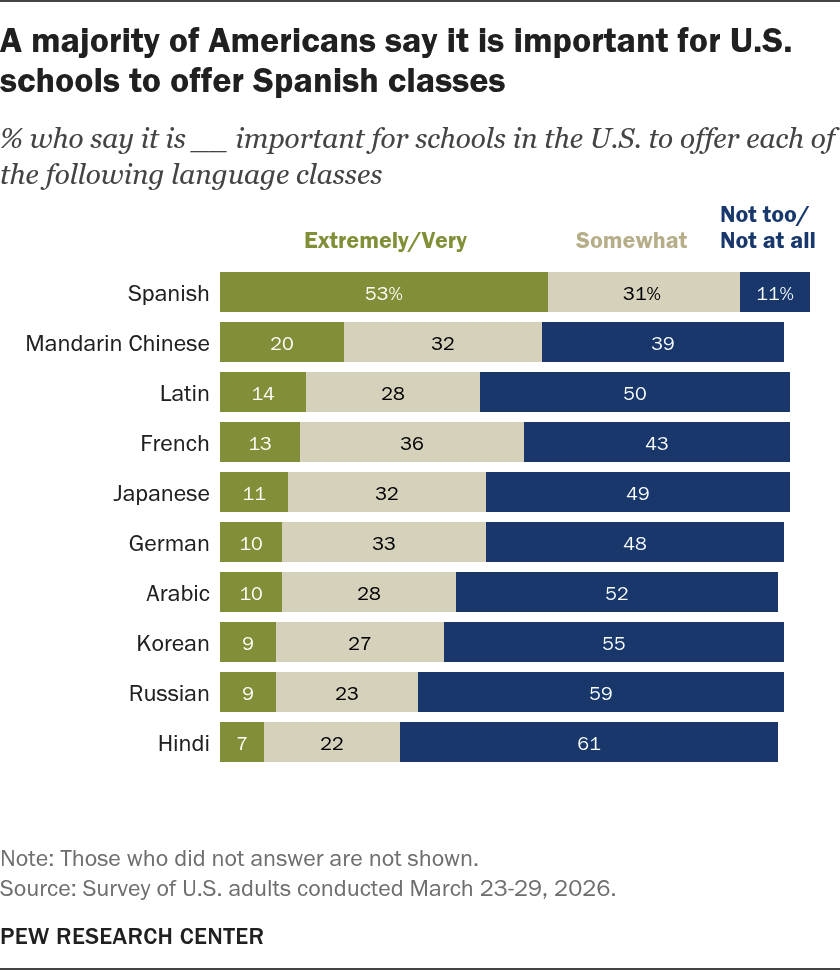
More than half of Americans (53%) think it is highly important for U.S. Schools to offer Spanish classes.
That’s the highest share of any of the 10 languages we asked about.
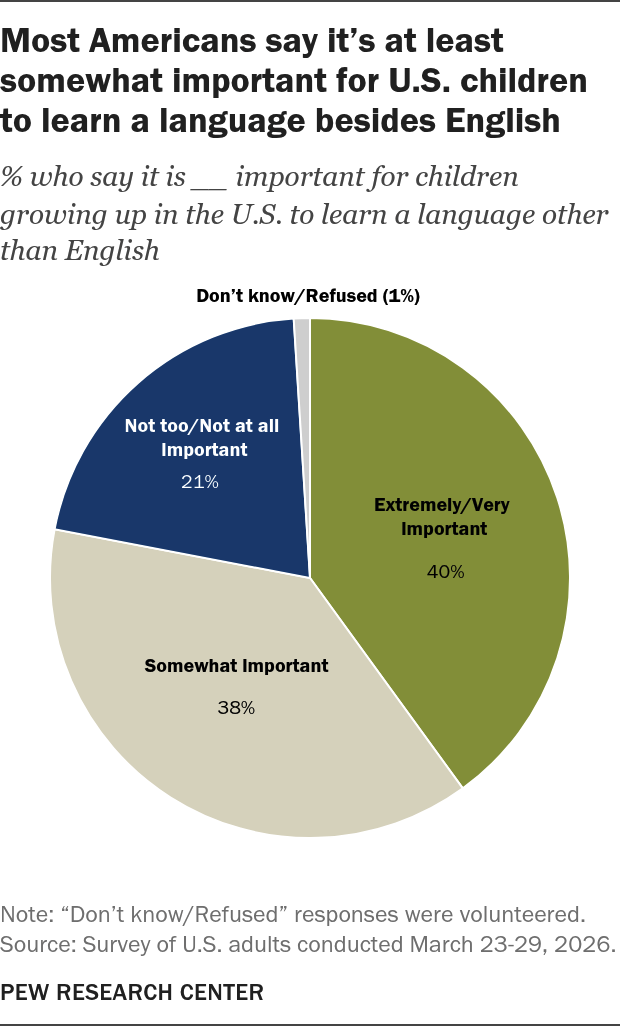
The survey of 3,507 adults was conducted from March 23 to March 29, with all participants being members of the Pew Research Center’s American Trends Panel, representing the full U.S. Adult population.
Spanish tops the list for a reason.
About 45 million people in the United States age 5 and older speak Spanish at home.
The massive figure undergirds the national sentiment.
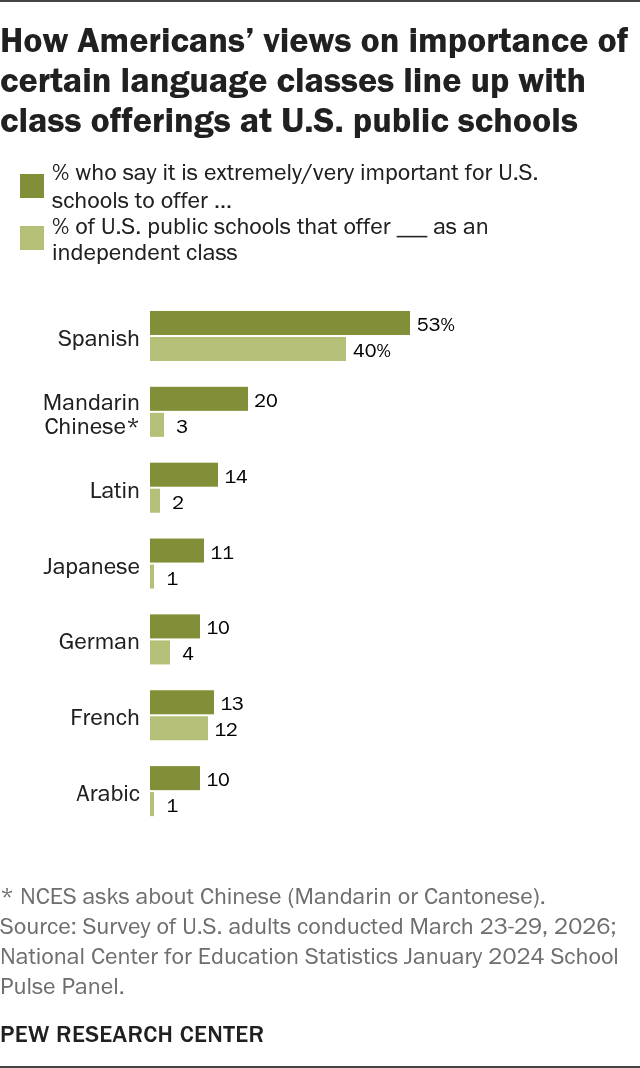
More than four-in-ten K-12 public schools (43%) offer such language classes, according to a 2024 poll by the National Center for Education Statistics (NCES), including 20% of elementary schools and 82% of high schools.
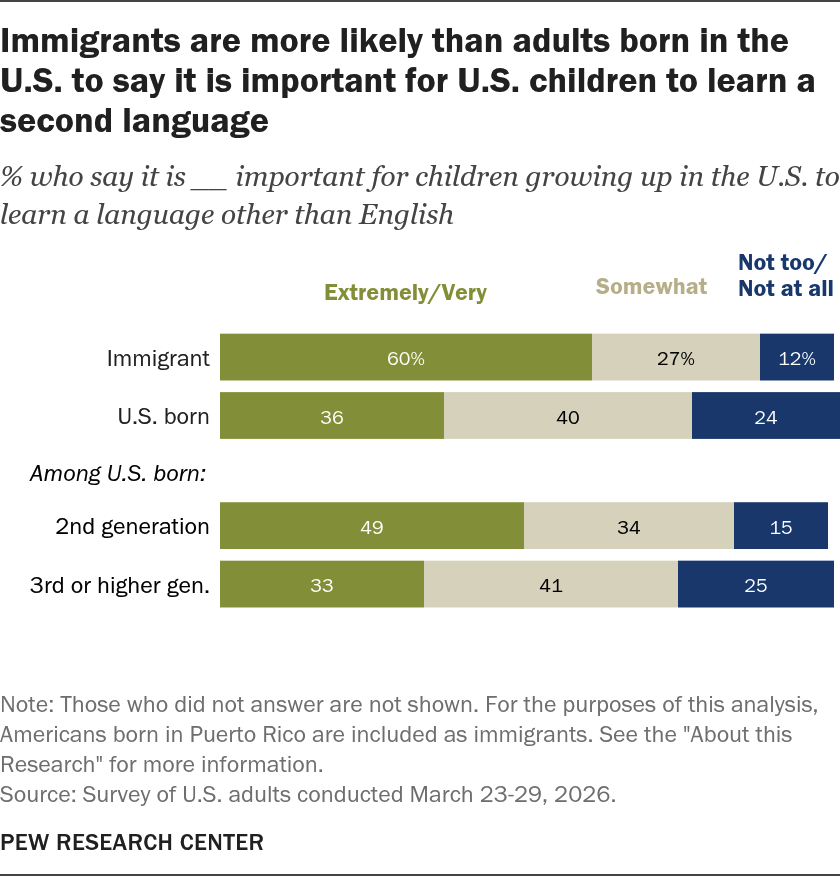
But support for Spanish education breaks sharply by region and immigration status.
U.S. Adults who say they live in urban areas are particularly likely to say language learning is important (52%), while suburbanites (40%) are less likely to say this, and Americans who live in rural areas (28%) are the least likely.
Immigrants heavily back the push.
When referring to survey respondents, the term “immigrants” includes people born outside the 50 U.S. States, the District of Columbia and U.S. Territories other than Puerto Rico; for this analysis, immigrants also include people born in Puerto Rico because they are born into a Spanish-dominant culture and because their attitudes, views and beliefs often are much closer to those of Hispanics born outside the U.S.
Education and gender also predict Spanish support.
Adults with bachelor’s degrees are more likely than adults with less education to say language learning is extremely or very important (45% vs. 37%).
Women are slightly more likely than men to say language learning is extremely or very important (42% vs. 38%).
The gap between what parents want and what schools deliver looms large.
A bilingual 2025 survey of nearly 1,400 Latine parents from Abriendo Puertas and UnidosUS found that “Eighty-eight percent of participants reported they want their children to be bilingual, and 92% said child care facilities should offer multilingual and multicultural education.”
Yet availability remains patchy.
In a 2024 TCF poll, nearly 70 percent of Latine respondents said they would choose bilingual education if it were available, compared to just 15 percent who said they preferred English-only education.
Political divides also shape attitudes on languages in schools.
Democrats are about twice as likely as Republicans to say learning a language other than English is extremely or very important, with 52% of Democrats and Democratic-leaning independents saying this, compared with 27% of Republicans and Republican leaners, and this difference persists even when controlling for factors like age, gender, education, urbanicity, ethnicity and place of birth.
Spanish dwarfs other languages in American classrooms.
Spanish is the world language that Americans think is most important for schools to offer, and it’s the most commonly taught, with four-in-ten K-12 public schools teaching it as an independent class, including 79% of public high schools.
Mandarin Chinese ranks second in demand.
20% of U.S. Adults in the survey say it’s important for schools to offer Mandarin Chinese as a language class, but only 3% of K-12 public schools offer Mandarin or Cantonese as an independent class, according to the 2024 NCES survey.
Beyond schools, Spanish learning flourishes.
Spanish is typically the most popular language studied on leading language apps in the United States in 2025, with over a third (36.45%) of Americans for whom Spanish is not a first language having attempted to learn it at some point.
The broader context reveals why Spanish resonates.
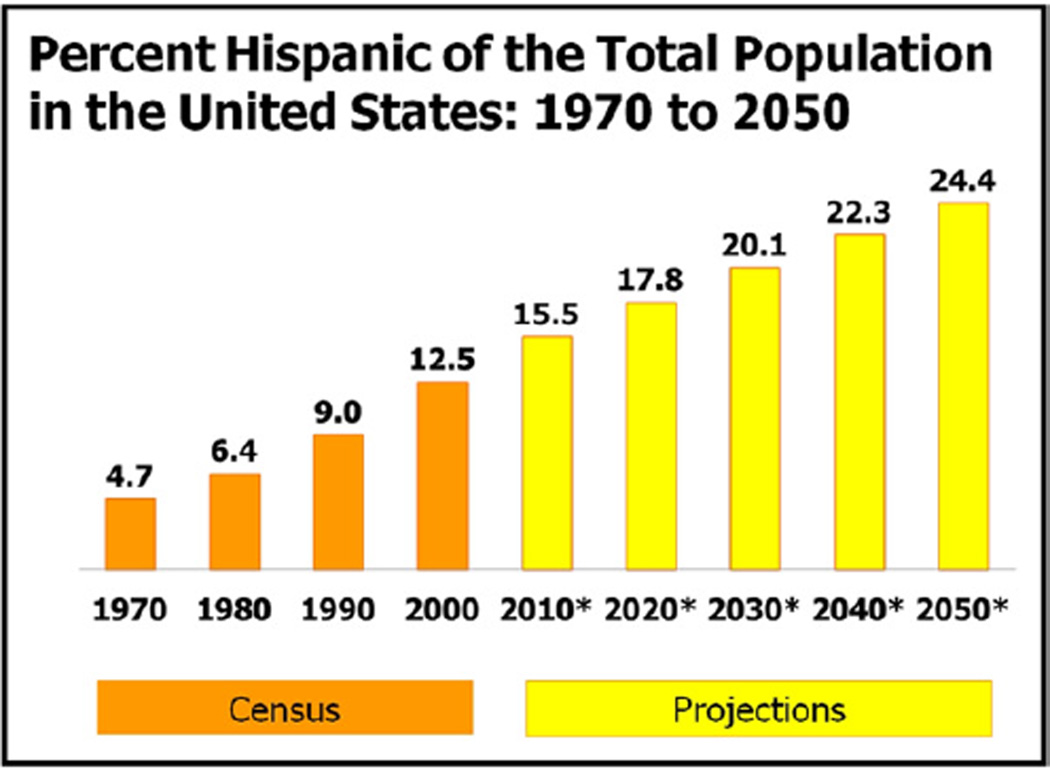
According to the 2024 American Community Survey conducted by the U.S. Census Bureau, 44.9 million people aged five or older speak Spanish at home—more than twice as many as in 1990—and Spanish is the most studied language in the United States after English, with approximately 8 million students enrolled in Spanish courses at various educational levels.
Long-term projections only heighten the stakes.
By 2050, the U.S. Is expected to have the largest Spanish-speaking population in the world.
Bilingual benefits go beyond communication.
Maintaining the home language of minority children such as Hispanics depends, to a great extent, on the linguistic environment provided by the school, and despite documented benefits associated with bilingualism and the fact that learning Spanish in school does not slow (and may in fact accelerate) the learning of English and content areas, U.S. Educational policies have not supported home languages and dual-language ability.
For many American families, the question of Spanish education touches identity and economic mobility.
An overwhelming majority of Hispanics say it is important that future generations of Hispanics living in the United States speak Spanish, according to a Pew Research Center Hispanic Trends report, with the survey “When Labels Don’t Fit: Hispanics and Their Views of Identity” finding that 75 percent of Hispanic adults say it is “very important” that young people speak Spanish while another 20 percent say it is “somewhat important,” and while nearly 90 percent of survey respondents still believe that Hispanic immigrants must learn English to succeed in the U.S., the findings “may reflect a recent shift in priorities,” with Hispanics now more likely to support bilingualism and heritage language retention.
Momentum for dual-language programs is building in major cities.
The shift may be reflected in K-12 trends, as in some of the nation’s largest school systems, including New York City and Houston, more resources are being poured into dual-language programs as interest in transitional bilingual programs plateaus.
The Pew survey was conducted March 23-29.