

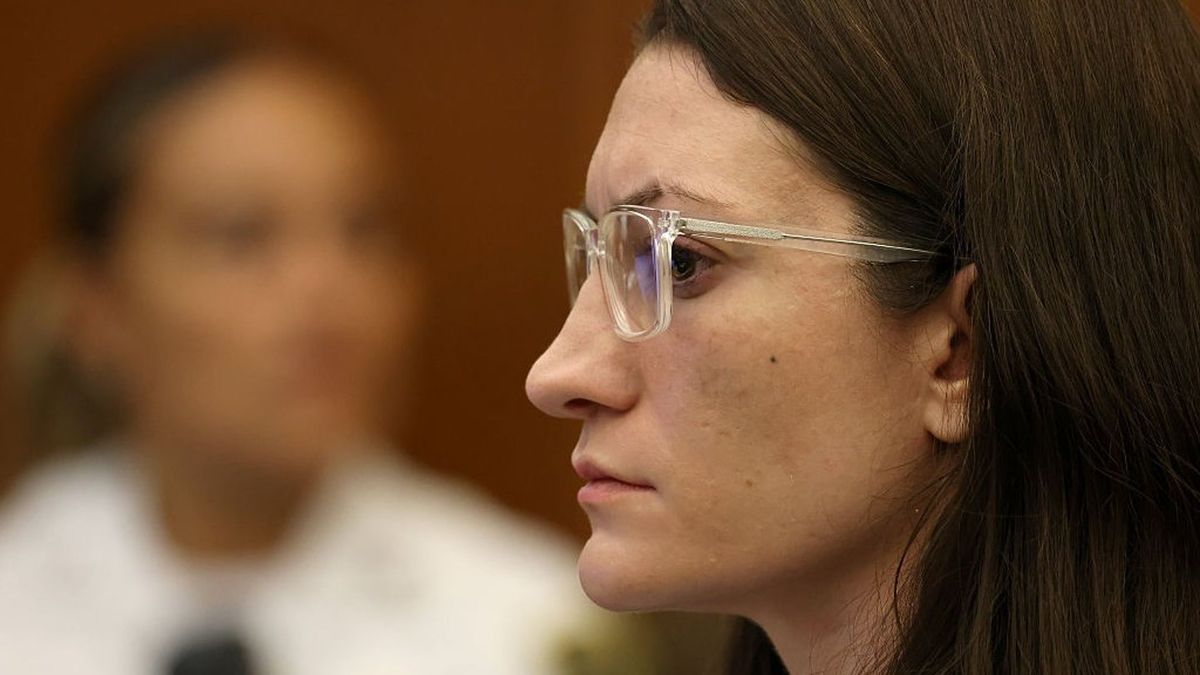
Lindsay Clancy’s attorney criticized a prosecutor during her murder trial after a courtroom hot mic appeared to pick up an alleged remark as the defendant cried while autopsy images were shown.
Clancy is facing trial over the deaths of her three children in January 2023: five-year-old Cora, three-year-old Dawson and eight-month-old Callan.
The issue arose while medical examiner Dr Kimberly Springer was testifying and photographs from Callan’s autopsy were displayed to the jury on Thursday, August 6, 2026. This was the eighth day of testimony in the case.
Kevin Reddington, who represents Clancy, raised the matter with Judge William F. Sullivan before a recess on August 7, according to MassLive.
Reddington told the judge he wanted to address a concern and chose not to do so at sidebar, where the discussion would have been out of the courtroom’s hearing.
He said a prosecutor was seemingly caught on a live microphone saying ‘shut her up’
During Dr. Springer’s testimony, Clancy trembled and wept at the defense table with her head down as the medical examiner described the injuries to eight-month-old Callan. Two jurors wiped tears from their eyes as they looked at the autopsy photos. Dr. Springer testified that the infant’s cause of death was “complications of mechanical asphyxia.” After stepping down without cross-examination, Judge Sullivan called a short recess as Clancy continued to weep.
The trial is continuing.
The case has drawn attention not only because of the allegations themselves, but also because of the detailed timeline presented in court about Clancy’s mental health, family life and the events leading up to the children’s deaths.
After the birth of her third child, Callan, Clancy shared posts on social media about postpartum difficulties she had experienced following her earlier pregnancies.
Six weeks after Callan was born, she wrote that she was feeling ‘dialed in’
She also said focusing on exercise, nutrition and mindset:
‘it has made all the difference’
As her maternity leave was coming to an end, Clancy, a labor and delivery nurse at Massachusetts General Hospital, began to feel anxious about going back to work.
She saw two psychiatrists and was diagnosed with generalized anxiety disorder.
She was then prescribed multiple psychiatric medications.
According to court documents, Clancy also wrote the following note on her phone:
“I think I sort of resent my other children because they prevent me from treating Cal like my first baby. And I know that’s not fair to them. I know that. I was feeling so depressed last evening when Cora and Dawson came home from school, I know it runs off on them, so we had a pretty rough evening, I want to feel love and connection with all my kids.”
Prosecutors have said Clancy later underwent an assessment at the Women and Infants Hospital Center for Women’s Behavioral Health, where she was not diagnosed with postpartum depression.
Patrick Clancy, her husband, later told police that she had spoken about suicidal thoughts and about harming their children, according to his testimony.
She was admitted to McLean Hospital for psychiatric treatment, but prosecutors say she was released after five days because clinicians did not believe she presented an immediate danger to herself or anyone else.
At another point, Lindsay and Patrick Clancy had dinner with their children Cora and Dawson at the home of family friend Kyle Carney.
Carney later told police Clancy had appeared:
‘seemed fairly normal’
Prosecutors also say she made another note on her phone describing concerns about returning to work as ‘a touch of postpartum anxiety’
During the seventh day of testimony on August 5, 2026, the children’s former nanny Elaine Rossi testified. She told the jury that she observed Clancy closely in the months before the killings and described her as a “wonderful mom who loved her kids” who was “very concerned with their safety.” Rossi said that while Clancy spoke to her about postpartum issues and lack of sleep, Clancy never mentioned any urge to harm herself or the children.
Jurors have also heard the prosecution’s account of what happened on the day the children died.
Morning: Prosecutors say Clancy took Cora to a scheduled pediatric appointment. After they got home, she played in the snow with Cora and Dawson and later sent photos of the children to Patrick and to her mother.
4:02pm: Clancy searched on her phone for kids’ Miralax. Eleven minutes later, prosecutors say, she searched for “take out 3v” and used Apple Maps to check the drive time from the family home to ThreeV in Plymouth.
4:35pm: She texted Patrick, who was working from home:
“Any chance you want to do takeout from 3V … I didn’t cook anything … It’s been a long day.”
Patrick agreed. Clancy then asked him:
‘check the menu when you can’
4:47pm: Clancy called a CVS in Kingston to ask whether Miralax was available. A manager told her the store did not have it, though similar products were in stock.
That manager later told investigators Clancy did not sound impaired and was not slurring her words during the call.
5:10pm: Prosecutors say Clancy phoned ThreeV to place the family’s takeout order.
5:15pm: She allegedly texted Patrick:
“Pedialax liquid stool softener.”
He then left the house to pick up the medication.
5:33pm: When Patrick arrived at CVS, he called Clancy but she did not answer. One minute later, she called back and confirmed the medication.
5:54pm: Patrick reached ThreeV, paid for the food and left.
6:09pm: He returned home.
Prosecutors said:
“The first thing he noticed was the silence,”
They also said:
“He did not see or hear the defendant or the children.”
According to the prosecution, Patrick called out for his wife but got no reply. He then found that the second-floor bedroom was locked. After getting inside, he allegedly saw blood on the floor and an open window, then ran outside and found Lindsay on the ground.
6:11pm: Prosecutors say Patrick called 911, while Lindsay said:
“I tried to kill myself and jumped out the window.”
He then asked:
“Where are the kids?”
She replied:
“In the basement.”
Prosecutors say Patrick went downstairs during the call and could be heard:
‘screaming in agony’
Cora and Callan were found on the floor of the den, while Dawson was discovered in his father’s home office.
When police got to the scene, prosecutors say Patrick alleged:
“She killed the kids.”
Lindsay was taken to hospital for injuries that left her paralysed from the waist down. The children were also transported for emergency treatment.
7:28pm: Cora and Dawson were pronounced dead. Callan was flown to another children’s hospital.
Police then obtained an arrest warrant charging Lindsay with two counts of murder, three counts of strangulation or suffocation and three counts of assault and battery with a dangerous weapon.
Callan was later pronounced dead at 11.18am.
Assistant District Attorney Jennifer Sprague has said Lindsay later regained consciousness and wrote on a whiteboard:
“Do I need an attorney?”
At another stage, while with a psychologist retained by her lawyer, Clancy called Patrick and told him she had experienced a ‘moment of psychosis’
She also said she heard:
‘a man’s voice telling her to kill the kids and kill herself’
That, she said, happened after Patrick left the house on January 24.
At her arraignment, Clancy’s attorney said she remained suicidal. She entered not guilty pleas to three murder charges.
Patrick Clancy later asked the public to forgive his wife, telling The New Yorker:
“I wasn’t married to a monster – I was married to someone who got sick.”
He and Lindsay later brought a civil lawsuit alleging medical providers failed to properly diagnose, treat and monitor what the suit describes as a ‘severe postpartum psychiatric condition’
The Plymouth County District Attorney’s Office has said the three strangulation counts would be subsumed into the murder charges.
Clancy’s 35-year-old defense team has admitted that she killed her children but argues she was suffering from postpartum psychosis at the time and should not be held criminally responsible. Prosecutors, however, contend that she planned the killings deliberately and methodically, using Apple Maps to ensure she had enough time to strangle each child before her husband returned from where she had sent him on errands.
During testimony on Tuesday, August 4, forensic scientists testified that toxicological testing showed Clancy’s blood and urine contained the antidepressant mirtazapine, the mood stabilizer lamotrigine, the antipsychotic quetiapine, and the antidepressant trazodone. The testing revealed no alcohol or recreational drugs in her system at the time of the killings. Toxicological testing on the three children detected no substances at all.
Clancy’s murder trial is now under way, with testimony expected to continue for six to eight weeks.