

Chevron has abruptly withdrawn from a federally funded carbon capture project in California’s Kern County after securing multimillion-dollar subsidies under the Biden administration.
The energy giant, headquartered in San Ramon, terminated its partnership with the U.S. Department of Energy for the Western Regional Direct Air Capture Hub in July 2025 following extensive negotiations, according to company spokesperson Chanel Jolly. Chevron has not issued any public statement explaining the reversal.
“Chevron’s agreement to a consensus termination of this award should not be construed as a reflection of the viability of the project, the performance or contributions of any participating subrecipient organization, Chevron’s position on other partnerships with DOE or DOE’s efforts to support CCS,” Jolly wrote in an email to The Bakersfield Californian.
The project had been positioned as the only local direct air capture initiative approved for substantial federal funding, making the withdrawal a significant blow to regional climate infrastructure plans. Local experts had viewed the development as potentially transformative for Kern County’s economy, given the area’s favorable geological formations for carbon dioxide storage.
Katy Larson, director of the California Energy Research Center at Cal State Bakersfield, noted that companies across the country have been eyeing Kern County as a testing ground for carbon capture technology. “DAC also has the ability to contribute to other economies (which is always an interesting conversation in Kern County as our economies are interconnected). Once the CO2 is captured, the CO2 may be utilized in agriculture, medicine, manufacturing, etc,” Larson told the news outlet in an email.
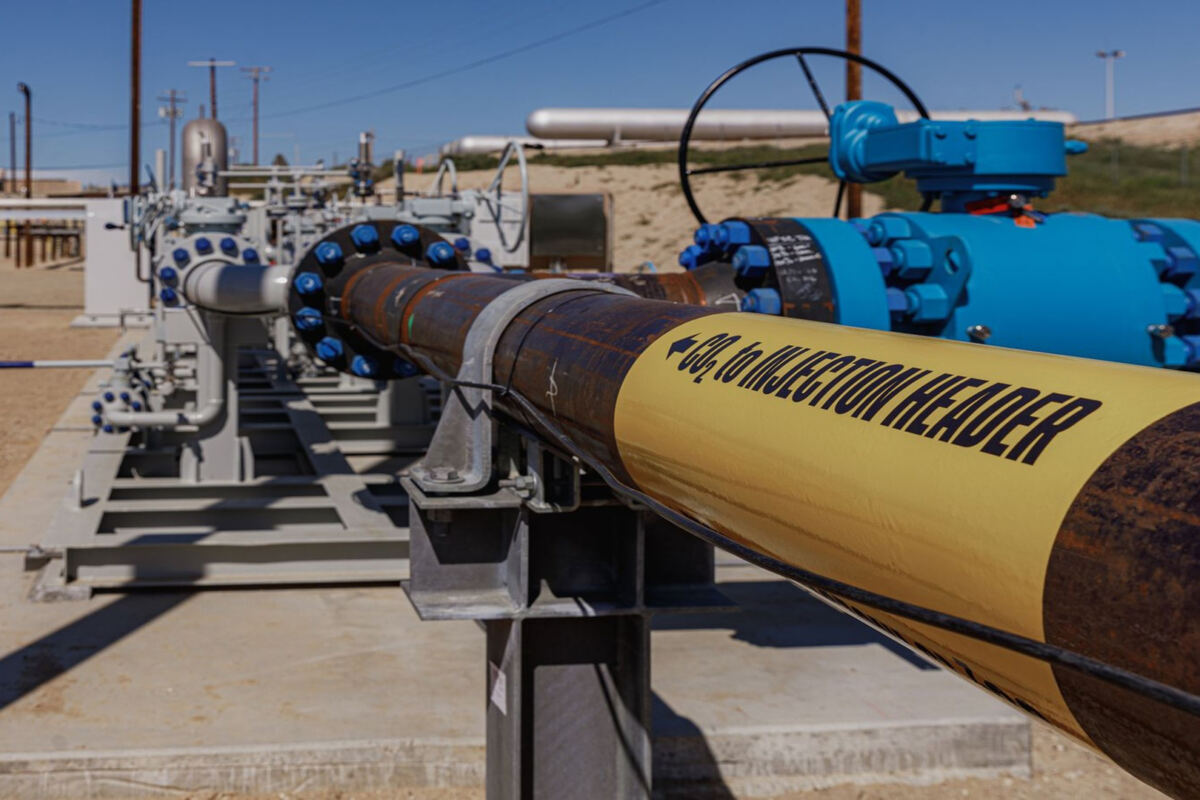
According to project documents, Chevron’s plan involved capturing carbon dioxide from the Eastridge Cogeneration Plant, a power facility tied to oilfield operations in Kern County. The captured gas would then travel through a new pipeline to a storage site within the Kern River Oilfield, where it would be injected into a saline aquifer spanning approximately 7,343 acres.
Over the project’s lifespan, Chevron had aimed to store up to 6.8 million tons of carbon dioxide underground. The infrastructure plan called for drilling two primary injection wells, two backup wells, and two pressure-management wells to maintain stable underground conditions.
The company had received a $3 million Department of Energy grant in August 2023 to study the project’s feasibility, according to Kern County records.
Chevron had promoted the Eastridge CCS initiative through its Chevron New Energies division, pledging to capture up to 300,000 metric tons of CO2 annually and generate roughly 150 local jobs. The company emphasized that many required skills would overlap with existing oil and gas expertise, framing the project as a workforce transition opportunity. Regional business leaders had rallied behind the proposal, with Central Valley Business Federation CEO Clint Olivier calling it “an essential step forward for California’s energy future and statewide carbon reduction goals.”
Chevron’s pullback arrives amid broader turbulence in the carbon capture sector, with the Trump administration rolling back climate funding and voluntary carbon credit markets showing weakness. California Resources Corporation recently became the first operator to begin active carbon injection in the state at its Elk Hills TerraVault facility, though that project faces ongoing litigation from environmental groups.