

Pete Firman has gone viral again with an optical illusion that tricks viewers into seeing colors that aren’t actually there.
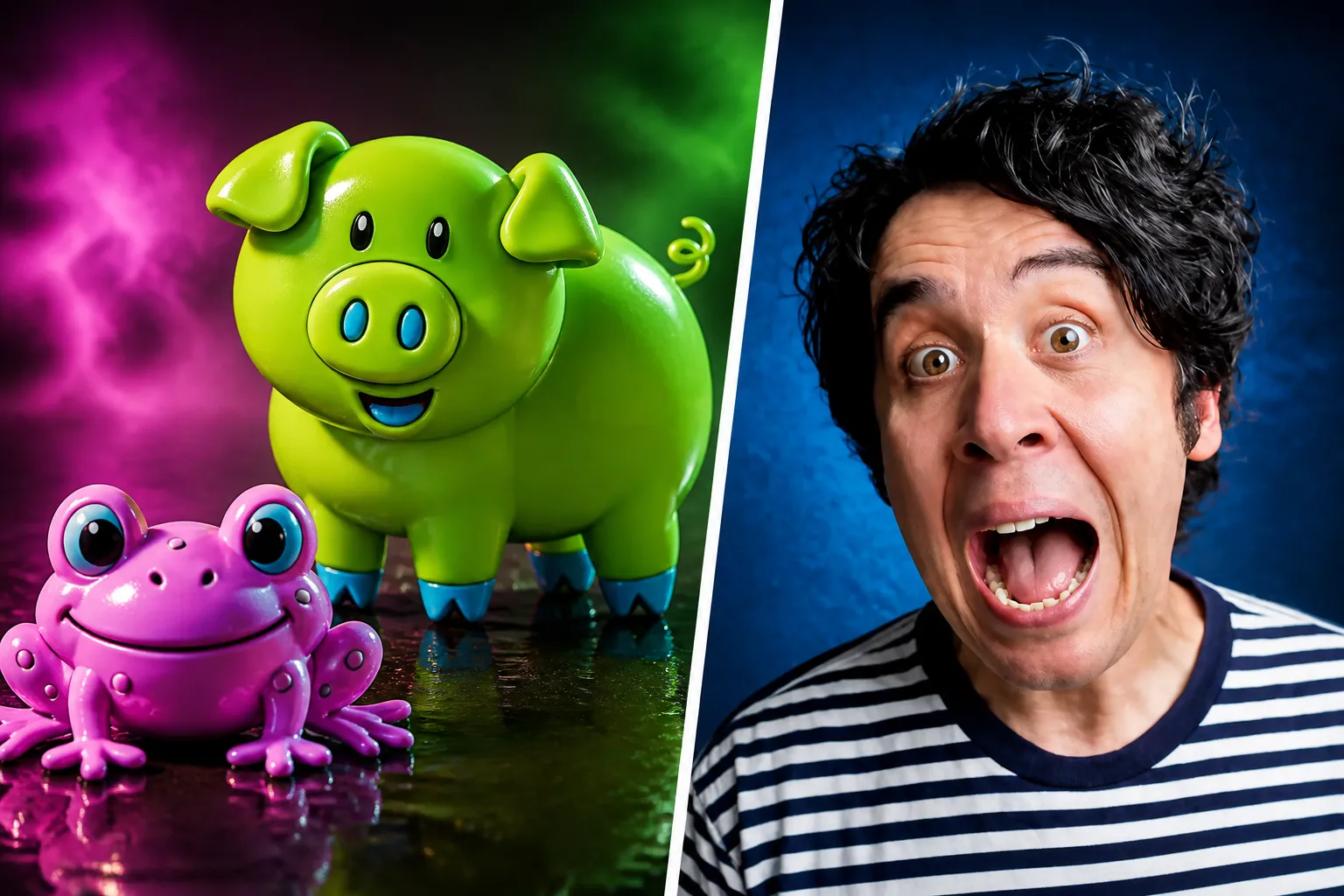
The British magician, 44, posted the clip to X on Tuesday, where it has since racked up more than 47.5 million views. In the video, Firman stands before an image of two cartoon animals—a frog colored purplish-pink and a pig rendered in bright, almost neon green—with a black “X” positioned between them. “I can make you see colours that don’t exist. Have a look at this image,” he says in the clip. “You’ll see that both of the animals are the wrong colours. But I’m gonna control your brain and make you fix this yourself. Keep staring at this black cross.”
He continues with specific instructions for viewers. “Keep staring at it. Try not to blink if you can help it. And also keep your phone an equal distance away from your face; that should strengthen the illusion,” Firman says. “You’re gonna see colours that aren’t actually there. In just a minute, I’m gonna take away the colours from my cartoon. But you will see the pig in bright pink and the frog in bright green.”
After a ten-second countdown, Firman removes the colors entirely, leaving only a black-and-white outline drawing. For many viewers, the pig then appears pink and the frog appears green—colors that exist only in their visual perception, not on the screen. The effect is known as a color afterimage, and it has sent social media into a spiral of disbelief and scientific curiosity.
On X, where Firman first posted the clip, reactions poured in by the thousands. “What is dis wizardry?!!!” One commenter wrote. Another fired back, “Man, hell nah, wtf are our eyes.” A third added, “How the f–k does this work. Do the colours get inverted because your brain knows the colours of the animals were wrong???”
The scientific explanation behind the trick has drawn significant attention from researchers and science communicators alike. Dr. Christoph Witzel, an Associate Professor of Psychology at the University of Southampton, has studied the phenomenon extensively. “Colour afterimages is an age-old classical phenomenon, but the more we have understood about it, the more it has become the subject of confusion amongst experts and in textbooks,” he shared in research published by the university. “Some say the phenomenon is caused by responses in the light-sensitive cone photoreceptor cells in our eyes, while others have argued it’s due to the neural pathways making us see opposing colours. Others have even suggested it’s due to some yet unknown mechanism in the brain.”
Witzel’s research team reached a definitive conclusion about the mechanism. “Across all the experiments, we found the same thing – afterimages are not caused by opposing colours, as many scientists have believed. Instead, they match what we’d expect if they were caused by how cone cells in the eye adapt to light. So, we have been able to say for certain that afterimages come from cone cells and not from other parts of the visual system,” he continued.
The illusion’s spread has prompted amateur science explanations across platforms. On Instagram, where Firman’s post has collected over 93,000 likes, one commenter offered a detailed breakdown: “Negative chromatic afterimage: When you stare at a colored light for a while and then look away, you may briefly see its complementary color. This happens because the color-sensitive cells in your eyes and visual system adapt to the prolonged stimulus, temporarily reducing their response. When you look at a neutral surface, the opposing color signal becomes relatively stronger, creating the illusion of the complementary color.”
Another viewer on the platform posed a broader philosophical question. “Well, it’s a humbling experience: how we see reality is through data from the visual sense translated by the brain. If it’s this much vulnerable, how do we know what we see is the way it is in reality?”
One particularly observant X user debunked a common misconception about the trick with video evidence of their own. “The post makes it seem like the shapes matter and your brain is assigning the ‘correct’ colors, but they don’t. The same effect works with squares,” they wrote, sharing footage of green and pink squares with an “X” in the middle that produced identical color transposition. The shapes of the animals, in other words, are irrelevant to the effect—it is purely the fatigued cone cells producing complementary colors.
Firman himself has built a substantial following through precisely this type of content. His social media presence regularly features demonstrations of visual and cognitive illusions, including a previous viral clip involving the Flash Face Distortion Effect. In that earlier video, he showed photographs of celebrities with a white cross between them, noting that “after a couple of seconds, something weird should start to happen. The faces begin to look distorted, disfigured. It’s like the features are all out of proportion.” He explained then that “your brain is holding onto previous images and overlaying them onto the new ones as they appear in your peripheral vision.”
Firman’s color illusion built on a demonstration that has circulated online before, including versions shared on TikTok in 2025. The core mechanism remains unchanged: prolonged fixation on a colored stimulus fatigues the specific cone photoreceptors responding to that wavelength, so that when the color is removed, the remaining active cones create an imbalance the brain interprets as the complementary hue. The green pig becomes pink, the pink frog becomes green, and viewers briefly inhabit a reality that exists nowhere outside their own visual system.
Firman continues to tour and perform, with his social media channels serving as both promotional platform and experimental laboratory for new ways to make audiences question their own perception.