

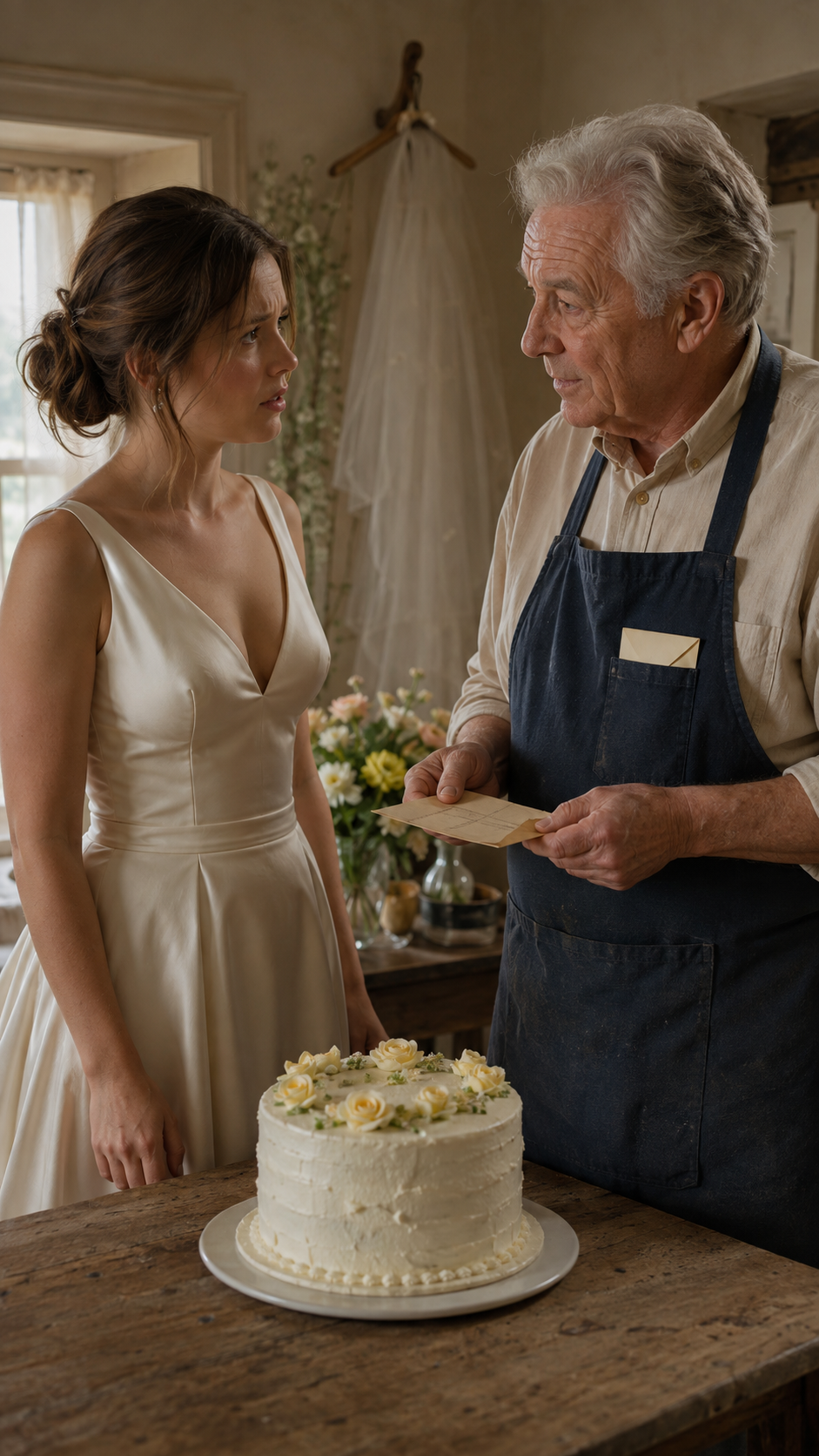
Nora was half an hour from putting on her veil when the baker arrived with a cake she hadn't ordered.
It was small enough for a kitchen table: white icing, pale yellow flowers, three uneven little leaves beside each one. Her wedding cake was already waiting at the venue. This one looked like something from another life.
The man behind it was in his seventies. He wore a clean apron and held a folded receipt between fingers that trembled slightly.
“Your mother paid for this,” he said.
Nora stopped reaching for her purse.
“My mother died twenty-two years ago.”
He nodded. Then he took a cream envelope from his apron.
“She left you something else.”
Across the front, in the handwriting Nora had practiced copying as a child, were four words.
For my grown-up girl.
She knew every curve of that writing. The leaning letters. The tiny loop her mother put through a capital G. For years, the only examples Nora had owned were a birthday card and her name on the back of a school photograph.
Now there was a whole envelope.
“Where did you get that?”
“From her,” the baker said. “My name's James. I used to have the shop on Willow Street.”
She remembered the shop before she remembered him. A bell over the door. A glass case too tall to see into without standing on tiptoe. Her mother lifting her just enough to choose a cookie.
James unfolded the receipt. It was dated six weeks before her mother died. Beneath an order for a lemon cake was another entry: wedding cake, date to be confirmed. Paid in full.
“She didn't know when,” he said. “She told me it might be twenty years. It might be forty. She said you might never want a wedding, and that would be all right too.”
Nora lowered herself onto the bench by the window. The satin of her dress made a soft scraping sound against the wood.
“How could she order it without knowing anything?”
“She knew you liked lemon. She said to check whether you still did.”
Nora looked at the little yellow flowers again. Little yellow roses. Her mother had made them for her eighth birthday, using the wrong nozzle and laughing when they came out lopsided. Those three little leaves were in the photograph from that day.
“She brought a picture,” James said. “Asked me not to improve the flowers.”
Nora covered her mouth.
Her mother, Grace, had been gone for most of her life. Sometimes that was the hardest part to admit. Nora could remember the feel of her cardigan more clearly than her voice. She had reached thirty with entire parts of herself her mother would never recognize: a job, a mortgage, a person waiting to marry her.
On difficult days, she had felt guilty about becoming someone new.
She opened the envelope carefully along the seam.
My Nora,
If you're reading this in a wedding dress, please check that you've eaten. You are very cross when you're hungry, and I doubt growing up has cured it.
A laugh escaped her, small and startled.
I wish I could tell you what your life will look like. I don't know who will be standing beside you. I don't know what your hair will look like, or whether you will still pull your sleeves over your hands when you're nervous.
I hope someone knows those things about you.
Nora pressed the letter flat against her knee.
There may be people who help you grow up after I can't. Someone who remembers a permission slip. Someone who comes to get you when you've had an awful evening. Someone who knows how you like your tea because they've made it a thousand times.
Please let them love you.
You don't have to keep a place empty to prove that it was mine.
Downstairs, someone laughed. Nora heard a familiar voice answering a question about where to put the buttonholes.
Ruth.
Her father had married Ruth when Nora was twelve. Ruth had never asked to be called Mom. She had learned which days to leave Nora alone and which days to sit outside her bedroom with two mugs of tea.
She had driven four hours to collect Nora after a breakup. She had kept the birthday card from Grace safe through three house moves. When Nora's father died five years earlier, Ruth had brought his shirts over one at a time because a whole bag was more than Nora could bear.
And when they planned this morning, Nora had told her she would get ready with her friends.
Ruth had said, “Of course. Tell me what you need me to do.”
Now she was downstairs organizing flowers.
Nora looked up at James.
“How did you know I was getting married?”
He hesitated.
“Ruth found me.”
Nora stared at him.
“Your father had my details with the receipt. I'd retired by then. My son's running a different shop now. She asked around until someone gave her my number.”
“She knew about this?”
“She brought the photograph so I could see the flowers clearly. Told me you still liked lemon.”
He looked toward the stairs.
“She asked me to come before you left. She said she thought you'd want a little time with your mother.”
Nora read the last lines of the letter.
Have a lovely day, sweetheart. Have a lovely ordinary Tuesday afterward, too. I wanted so many of those for you.
All my love,
Mom
She sat for a moment with the paper in her lap. Then she stood, lifting the front of her dress so she wouldn't tread on it.
Ruth was in the hallway, a buttonhole pin between her teeth. She took it out when she saw Nora.
“Is everything all right? Did the cake—”
Nora put her arms around her.
Ruth went still. Then she held her back, carefully at first, trying not to crease the dress.
“Come upstairs,” Nora said.
“Your friends are—”
“I know. I want you there.”
Upstairs, James had left a knife beside the cake. Nora cut three small slices, unevenly, and Ruth found plates. For a few minutes, nobody checked the time.
Then Nora handed Ruth her veil.
“Will you help me?”
Ruth's hands shook a little as she fitted the comb into Nora's hair. In the mirror, Nora could see the cake on the table, the open letter beside it, and the woman standing behind her.
When the photographer knocked, Nora reached back and took Ruth's hand.
“Stay,” she said. “You're in this one.”