

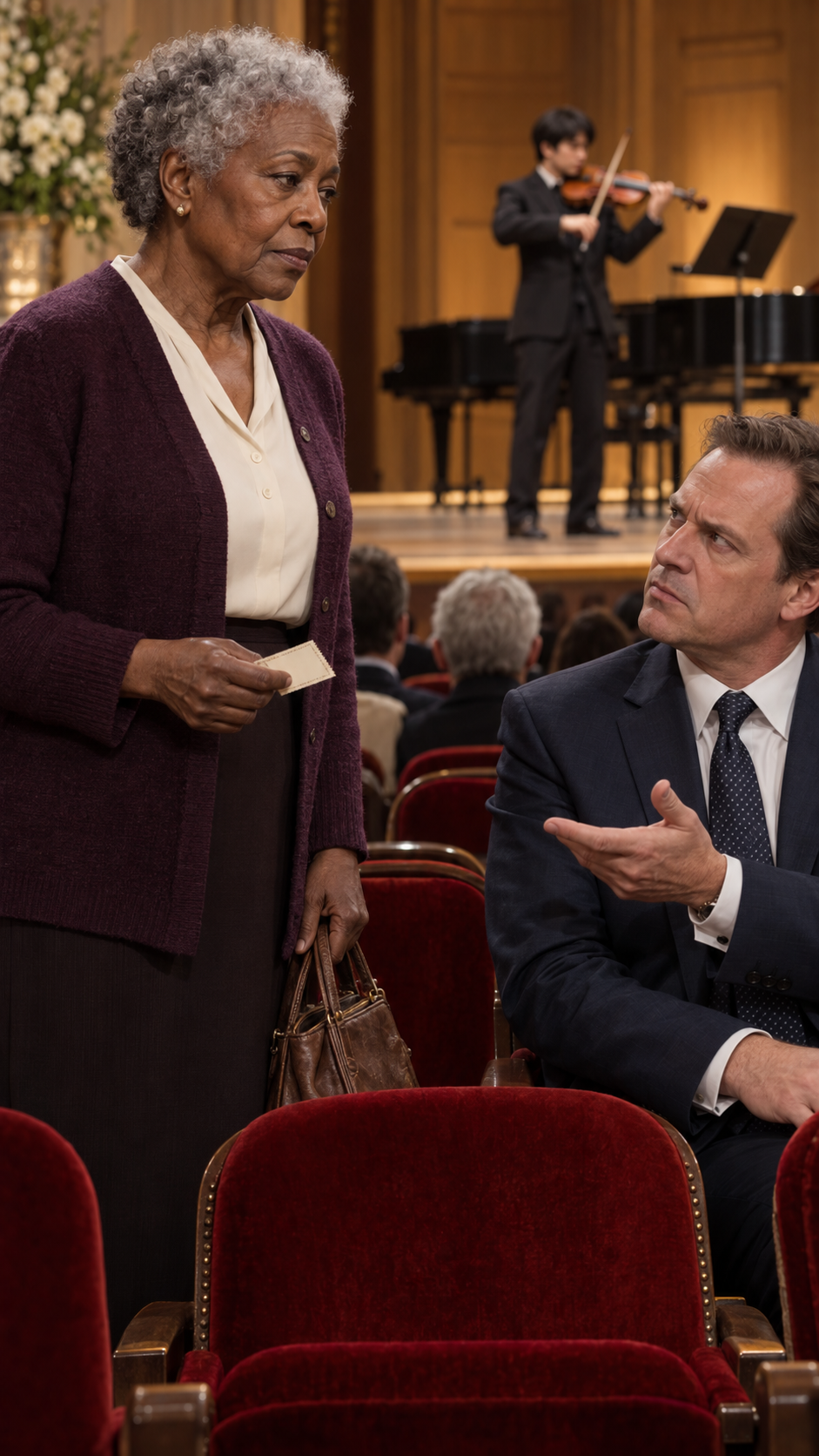
The man beside the empty seat glanced from Ruth’s cardigan to the ticket in her hand.
“Are you sure you’re in the right row?”
Ruth checked the little cream rectangle again. Row A. Seat 12. She had checked it on the bus, at the entrance and under the light beside the auditorium door.
“Yes,” she said. “I think I am.”
He moved his coat from the seat slowly, as though granting her a favor. Ruth sat down and tucked her brown handbag beneath her knees.
Around her, people were opening glossy programs. She left hers closed. On the cover was a face she knew, although she had not seen it for nearly twenty years.
Back then, Daniel Park had been a small boy carrying a violin case with a broken handle. Ruth cleaned his elementary school. Most afternoons, she found him outside the locked music room, sitting on the floor until his mother finished work.
One evening, she asked why he never practiced while he waited.
“My neighbor bangs on the wall,” he said. “And the music room closes at four.”
Ruth could not teach him a single note. But she knew the principal, and she knew that an empty classroom was not doing anybody much good.
By the following Monday, Daniel had permission to practice while she cleaned the corridor. The arrangement came with rules: his mother had to agree, the principal had to be in the building, and Daniel had to leave the room exactly as he found it.
He took the rules seriously. He straightened every chair before opening his case.
For two years, Ruth heard scales through the door. Some days the same four bars followed her from one end of the hallway to the other. When Daniel apologized for playing badly, she told him she was getting very good at that particular stretch of floor.
Then his family moved away.
At first, a holiday card arrived at the school. Later there were fewer cards, then none. Ruth retired. The school replaced its windows. The music room became a computer lab.
She kept one thing: a folded sheet of notebook paper Daniel had left on her cart. He had drawn a crooked stage with twelve little seats. One had a star above it.
Someday you can sit here, he had written.
Ruth never expected him to remember.
Three weeks before the concert, a letter arrived. Daniel had tracked her down through the school office. Inside were a ticket, arrangements for her journey and a note asking whether she still had the drawing.
Now, in the front row, she felt for the folded paper in her handbag.
The house lights dimmed. Daniel stepped onto the stage and lifted his violin. Ruth leaned forward, ready for the first note.
Instead, he lowered his bow.
“Before we begin, I need to thank someone who doesn’t appear in my biography.”
He looked directly at her.
“Mrs. Ellis, would you mind standing?”
For a moment Ruth could only shake her head. Then she stood, one hand resting on the armrest.
Daniel told the audience about the locked room, the principal’s permission and the woman who listened from the corridor. He mentioned the teachers who had trained him and his mother, who had worked late to afford the lessons. Ruth was glad he did. She had never wanted to be made into the whole story.
“Mrs. Ellis gave me somewhere to keep trying,” he said. “Tonight, I finally get to play somewhere she can sit down.”
People began applauding. Ruth pressed her fingers against her lips.
The man beside her stood too. When they sat, he leaned toward her.
“I’m sorry about earlier.”
“Thank you,” she said, and turned back toward the stage.
After the concert, Daniel found her waiting by the aisle. She took the old drawing from her bag and unfolded it between them.
He laughed softly at the little chairs.
“I got the row right,” he said.
“You did.”
He asked whether she had enjoyed the music.
Ruth looked at him for a long moment, seeing the boy on the floor outside the classroom and the grown man standing before her.
“Very much,” she said. “But I was always going to come, Daniel. You didn’t have to become this good.”
From our fiction collection.