

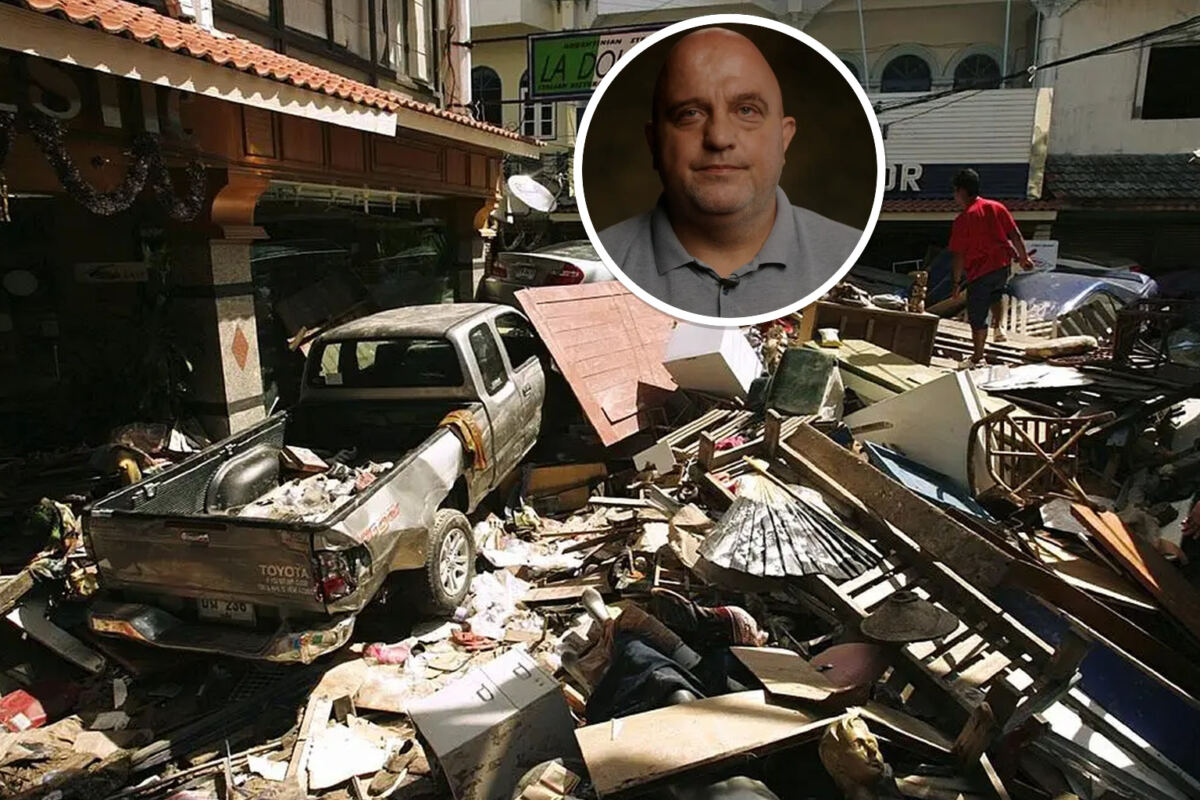
Andrew Chaggar has spoken out about the moment the 2004 Boxing Day tsunami destroyed his Thai bungalow and swept him into a debris-filled torrent that killed his partner Nova.
Chaggar, 27 at the time, was on a year-long round-the-world trip with Nova when they settled in Khao Lak, Thailand, in a small complex of roughly 10 bungalows sitting about 30 meters from the beach. Because the buildings sat at right angles to the shore, the couple could see nothing from their window when they woke to violent shaking and a deafening roar early on December 26, 2004.
“The bungalow was starting to shake, and that shaking was getting more and more violent,” he recalled in an interview. Nova was already standing on the opposite side of the bed, looking around in alarm.
“I remember her looking around and saying, ‘What’s that? What’s that noise? What’s happening?’ I remember her looking quite scared.”
Chaggar said he had barely risen from bed when the first wave struck the bungalows in sequence. “Ours was probably about the third or fourth along. I literally remember being in the bungalow and, the next minute, basically waking up in the water,” he continued. He could not say whether the impact knocked him unconscious or merely stunned him.
The force of the water left him helpless. “It was almost like being in a washing machine full of nails. There was this incredibly strong current, and there was just no way to swim against it. I was completely at its mercy.”
The current carried more than water. “In the water, there was metal, glass, bricks, probably whole cars and things like that. It was that powerful.” Chaggar believes an oil drum struck his head, leaving a scar, before the surge carried him inland through a hotel construction site of concrete floors and pillars.
His left leg became pinned against one of those pillars, causing his worst injuries. “So, although it caused the worst of my injuries, I think that’s fundamentally why I’m alive today,” he said, noting that the pillar likely prevented him from being dragged back out into the bay.
He remained trapped on the site for roughly four hours before two Western men found him and helped him down, even as someone shouted that another wave was approaching.
About six months later, police told Chaggar that a partial dental match and a photograph of a necklace he identified as hers had confirmed Nova was among the roughly 230,000 people killed across Indonesia, India, Sri Lanka and Thailand, according to British Red Cross figures.
The disaster reshaped Chaggar’s life. He went on to found the charity International Disaster Volunteers, which he led for a decade, and has since married and had two young children.