

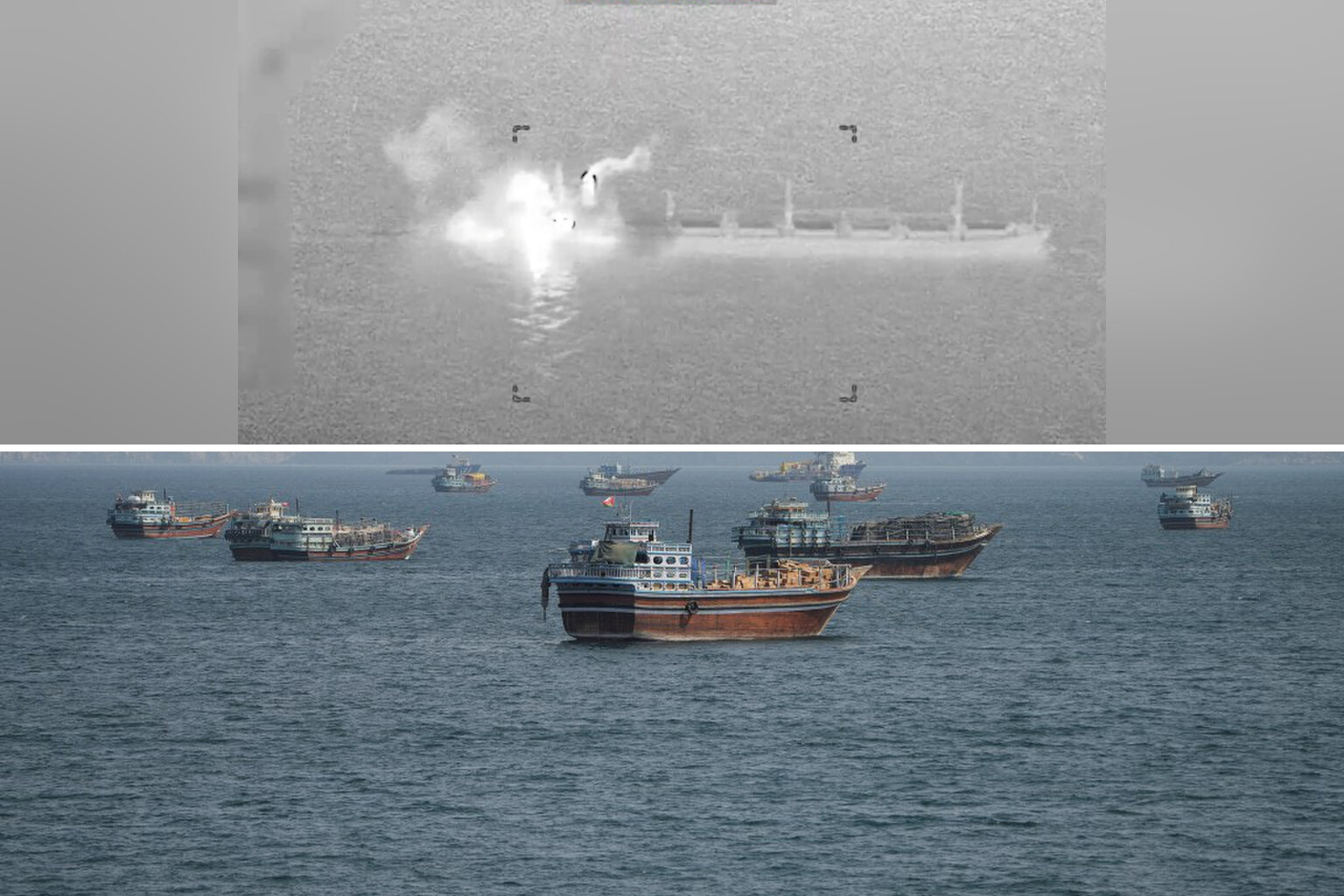
A supertanker erupted in flames after being struck in the Strait of Hormuz on Sunday, the UK Maritime Trade Operations confirmed, just hours after U.S. Forces disabled a cargo vessel attempting to break Washington’s naval blockade on Iran.
The unidentified tanker was hit on its port side, sparking a blaze that drew immediate claims of responsibility from Iran’s Islamic Revolutionary Guard Corps. The IRGC insisted the vessel had struck one of its naval mines and exploded, then circulated footage of the burning ship to reinforce its message.
“A devastating fire is the fate of any tanker that violates the rules and disregards security in the Strait of Hormuz,” the elite military unit declared in a statement. The IRGC has repeatedly threatened to target any ship crossing the chokepoint without Iranian authorization.
The twin incidents capped one of the most violent weeks for commercial shipping in the strategic waterway since hostilities began. At least 11 tankers came under attack during the week ending October 4, according to the United Nations’ International Maritime Organization, marking the highest weekly tally since the war started February 28.
Another 10 strikes occurred in the preceding week alone. One attack last Monday left 12 Indian sailors injured aboard the United Arab Emirates-owned On Peace oil tanker, underscoring the human cost of the escalating maritime conflict.
U.S. Central Command had moved hours earlier against the Panama-flagged M/V Ocean Molica, also known as the Arika Sun. “A US military fighter jet struck the stern of Panama-flagged M/V Ocean Molica (also known as the ‘Arika Sun’) with a precision munition, fully disabling the ship’s propulsion without harming the crew,” CENTCOM wrote in a statement.
The targeted vessel had allegedly docked at an Iranian port and was attempting to reach international waters when it was hit, CENTCOM added. The action represented the latest enforcement of a blockade Washington renewed three months ago.
American forces have now disabled four ships and turned back another 135 since the blockade resumed, according to military figures. Yet crude oil continues to flow at roughly pre-war levels under U.S. Military escort, steadily eroding Tehran’s bid to assert dominance over the passage through which roughly one-fifth of global oil shipments travel.
Iran has responded with near-daily attacks in the strait, keeping commercial operators and naval forces on constant alert. The IRGC’s mine claim regarding Sunday’s supertanker fire remains under investigation by maritime authorities, with the UK Maritime Trade Operations tracking the incident but not confirming the cause of the explosion.
The sustained violence has transformed the narrow waterway into one of the world’s most dangerous commercial shipping routes, with multiple nations’ vessels caught in the crossfire between American enforcement actions and Iranian retaliation.
The blockade itself dates to Washington’s effort to pressure Tehran by restricting maritime traffic, a strategy that has intensified since the broader regional war erupted in late February.