

—
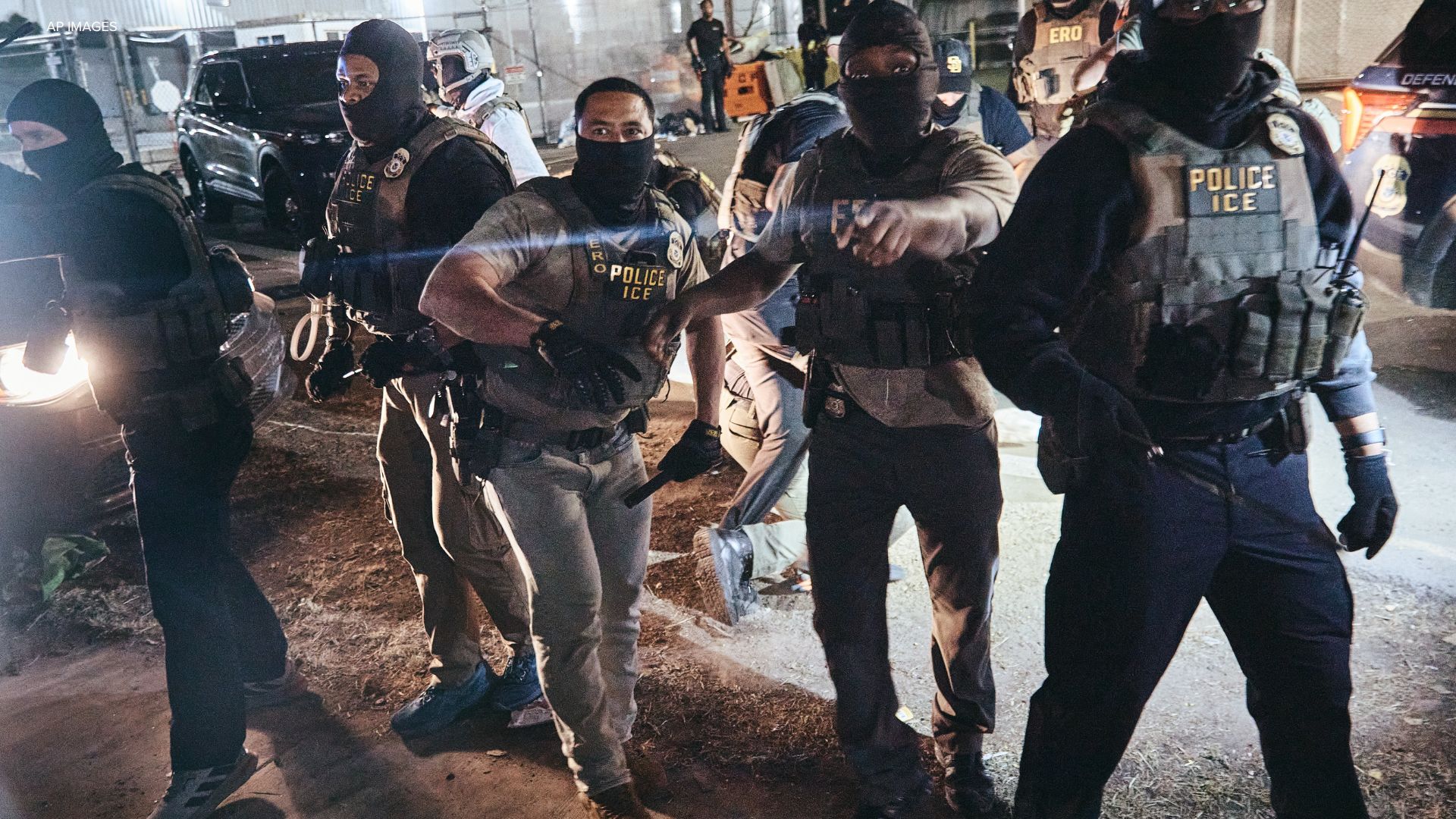
A federal judge has blocked New York’s law prohibiting federal immigration agents from wearing face coverings or hiding their identities, ruling that states lack the constitutional power to regulate how federal law enforcement conducts its operations. The decision was issued Monday by U.S. District Judge Mae D’Agostino of the Northern District of New York as a preliminary injunction, temporarily halting enforcement of what New York officials had championed as a transparency and accountability measure.
The ruling represents a significant victory for the Trump administration’s Justice Department, which challenged both of New York’s recent immigration restrictions. D’Agostino determined that the state’s face covering and identification requirements directly violated the Supremacy Clause of the U.S. Constitution, which bars states from regulating federal agency operations. “New York cannot impose its own uniform requirements on federal agents simply because it disagrees with how the Federal Government is exercising its authority,” D’Agostino wrote in her 51-page decision.
The judge acknowledged New York’s stated intentions. “New York appears to be well-intentioned in its pursuit of transparent policing,” she noted. But she emphasized that constitutional authority, not policy preference, was the real issue at stake. “The issue now before the Court is about constitutionality—not transparency or preferable policy decisions,” D’Agostino wrote.
Governor Kathy Hochul and Attorney General Letitia James had enacted the mask and identification restrictions in May 2026, responding to what they characterized as aggressive and concerning tactics by Immigration and Customs Enforcement agents under the Trump administration. The law took effect in June. The officials responded to Monday’s ruling by reaffirming their position. “While the court enjoined enforcement of New York’s mask ban, we stand firm in our belief that masked agents do not make New York safer and our offices are reviewing all legal options at this time,” Hochul and James said in a joint statement.
The ruling does not prevent local police from arresting ICE agents for covering their faces in public settings going forward, significantly narrowing a enforcement tool that state authorities had sought. However, D’Agostino’s decision contained a partial victory for the state: she refused to block a separate provision in the law that bans local law enforcement agencies from entering into 287(g) cooperation agreements with federal immigration authorities. These agreements, authorized under federal law, allow state and local police to be trained by ICE to conduct certain immigration enforcement functions.
D’Agostino ruled that New York retained authority over its own law enforcement agencies and their resource allocation. “The state has the authority to protect public welfare and decide how state and local resources are expended,” the judge wrote, allowing the state’s prohibition on these cooperation agreements to remain in effect. The ban is set to take full effect in late August.
The New York ruling follows a pattern of federal courts nationwide striking down similar measures in other Democratic-controlled states. Federal judges in California, Virginia, and Pennsylvania have all issued preliminary injunctions blocking comparable mask ban laws. In California, a federal court found that a state law requiring visible identification for federal officers violated federal principles, though it allowed the state to pursue amended versions that apply equally to state and local officers.
The Justice Department has aggressively litigated these state laws since Trump’s return to office. The DOJ has filed lawsuits challenging mask bans and identification requirements in Connecticut, New Jersey, New York, and other states, arguing consistently that such measures unconstitutionally attempt to regulate federal officers. Assistant Attorney General Brett Shumate celebrated the New York ruling, stating that federal courts have “enjoined the State of New York’s Face Covering and Identification Acts because states have no authority to regulate federal officers under the Constitution’s Supremacy Clause.”
Federal officials have argued that allowing masks serves legitimate safety purposes. The Trump administration contends that ICE agents wearing masks and concealing their identities protects them from harassment, violence, and being publicly identified, or “doxxed.” The Department of Homeland Security has reported that DHS law enforcement has experienced more than 180 vehicle attacks since Trump took office, and ICE officials have cited substantial increases in assaults against agents.
Some Democratic state legislators have signaled they may continue fighting the ruling. State Senator Pat Fahy, an Albany Democrat who pushed for the masking restrictions, said the decision could still be appealed. “We always knew there was a constitutional debate on this,” Fahy said. “But either way, we know that the push from us, along with others, has been effective in sending the message that this was totally outrageous—the actions of ICE.”
The law represented part of a broader Democratic strategy to constrain federal immigration enforcement operations. Supporters argued that mask and identification requirements would promote government transparency and hold federal agents accountable for their actions. They contended that the measures would help protect immigrant communities from what they viewed as excessive or abusive enforcement tactics.
But Republicans and the Trump administration rejected these arguments, contending that state efforts to regulate federal agents undermine national immigration enforcement and handcuff law enforcement efforts. The Justice Department’s legal position, consistently upheld by federal courts so far, is that the Constitution reserves immigration enforcement authority to the federal government alone and prohibits states from interfering with how federal agencies carry out their duties.
The 287(g) cooperation agreement issue presents a separate legal question that courts have treated differently. These agreements, which allow trained local officers to assist with immigration enforcement, have become a cornerstone of the Trump administration’s expanded deportation operations. The number of such agreements has grown dramatically under Trump’s second term. The expansion from roughly 150 at the end of Trump’s first term to over 1,300 by early 2026 represents the most significant shift in how immigration enforcement operates at the local level.