

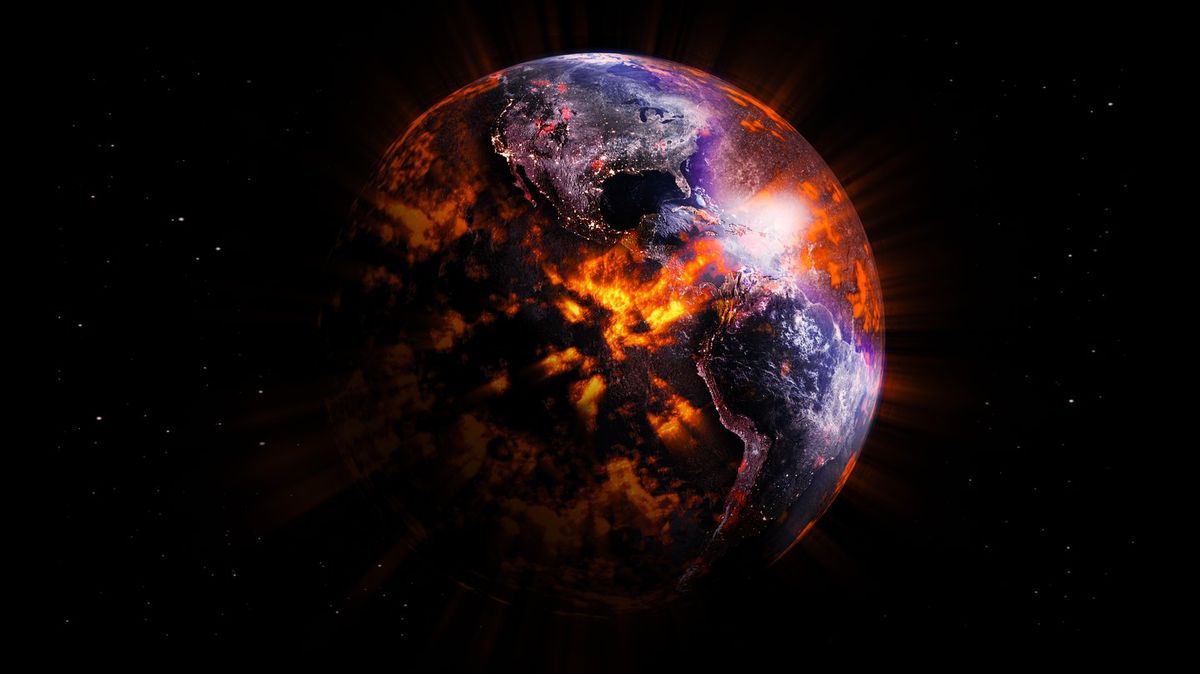
A physicist’s 1960 doomsday equation has resurfaced online, predicting humanity’s end on November 13.
The prediction comes from Austrian scientist Heinz von Foerster, then a professor at the University of Illinois, who published a paper in the journal Science in November 1960 alongside colleagues Patricia M. Mora and Lawrence W. Amiot. Von Foerster, a respected polymath who worked across computer science, physics, and systems theory and had collaborated with the Pentagon, examined nearly 2,000 years of population data and found that growth was not merely increasing but accelerating.
Von Foerster discovered that while population doubling once took centuries, the interval had been shrinking dramatically. He projected that if this pattern held, eventually there would be no time at all between doublings, leading to a theoretical point where population would “approach infinity.” He chose Friday, November 13 as the date when this mathematical singularity would occur, a date that happened to be his own birthday.
“Our great-great-grandchildren will not starve to death; they will be squeezed to death,” von Foerster wrote in the paper, which he titled “Doomsday: Friday, 13 November AD 2026.”

He also expressed hope in his paper that “at some time, somehow, something will happen that will stop this ever-faster race to self-destruction.”
The equation was never intended as a literal prophecy. Von Foerster later acknowledged the prediction was deliberately tongue-in-cheek, using exaggerated mathematics to illustrate the dangers of unchecked population growth. The paper was a thought experiment rather than a forecast meant to be taken at face value.
Demographic experts today say the theory does not hold up. Since the 1960s, global population growth has slowed markedly rather than continuing to accelerate. During the 1960s, population doubled roughly every 32 years, but that interval has stretched to about 83 years today. The United Nations now projects that global population will peak in the 2080s at approximately 10.3 billion before declining by around 700 million by 2100.
The current global population stands at approximately 8.2 billion, far below the infinite growth von Foerster’s equation predicted for this point. More than half of all countries now have flat or negative growth rates, driven by urbanization, improved healthcare reducing infant mortality, and economic shifts leading families to choose fewer children.
The 2026 date has circulated across social media platforms and news aggregators, often stripped of the crucial context that von Foerster’s work was satirical and that population trends have diverged sharply from his model. The story has been shared alongside unrelated doomsday predictions, including recent warnings from AI researchers about artificial intelligence risks and the Bulletin of the Atomic Scientists’ Doomsday Clock, which was moved to 85 seconds to midnight in January 2026, the closest to catastrophe in its history.
For those seeking more distant timelines, scientists from Toho University in Japan, collaborating with NASA, published a study titled “The future lifespan of Earth’s oxygenated atmosphere” that ran 400,000 computer simulations. Their research predicted Earth will become unlivable in approximately 1,000,002,021 years, tied to the lifespan and evolution of the Sun.