


Former FBI Director James Comey’s legal team has accused federal officials of significant prosecutorial misconduct in the case against him over an Instagram post of seashells, alleging that investigators misled judges, submitted false statements, and deliberately withheld key facts during the investigation.
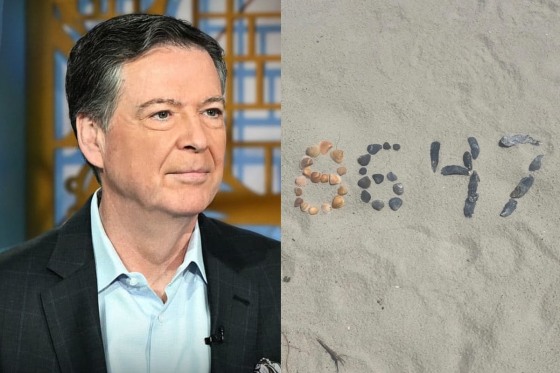
Comey’s attorneys filed the misconduct allegations in motions late Tuesday seeking dismissal of charges that he threatened President Donald Trump through a photo posted in May 2025 showing seashells arranged to form the numbers “86 47.” The two-count indictment, secured in April 2026, alleges Comey knowingly and willfully threatened to take the life of and inflict bodily harm upon the president and transmitted a threat through interstate commerce.
In their filings, Comey’s lawyers detailed specific instances of alleged investigative misconduct. Investigators obtained an affidavit from an unnamed individual claiming to have immediately perceived Comey’s post as violent. However, defense attorneys argue that investigators deliberately omitted from the affidavit that the person initially interpreted the number “86” as referring to being “out of something on the menu”—a common restaurant usage—and only later concluded it could constitute a call to violence. That change of interpretation, according to Comey’s team, occurred after the person listened to an episode of Rudy Giuliani’s online show in which Giuliani falsely claimed that Comey had worked on mob cases as a prosecutor where mafia members used “86” to mean “kill.” The FBI’s own investigation determined Giuliani’s claims to be untrue, the defense noted.
Additionally, Comey’s attorneys allege that search warrant affidavits “omitted facts known to the affiant” and “misled the magistrates with material falsehoods, bizarrely insinuating” that Comey’s lawyer—a former U.S. Attorney—and Comey’s wife had obstructed the government’s investigation. The defense is seeking a Franks hearing, a court proceeding where a judge determines whether the government misled or lied to obtain search warrants.
The allegations of misconduct are part of a broader legal strategy by Comey’s eight-member defense team seeking to dismantle what they characterize as a politically motivated prosecution. In separate motions filed Tuesday, his attorneys also argue that the case constitutes selective and vindictive prosecution, contend the post represents protected First Amendment speech, request access to grand jury transcripts to expose “irregularities” in how the indictment was secured, and describe what they claim were “unlawful” surveillance operations conducted by the U.S. Secret Service.
According to Comey’s legal team, the Secret Service conducted electronic surveillance of the former FBI director at the direction of senior officials, including as Comey and his wife stopped to visit the grave of their deceased son. Comey’s lawyers argue that Secret Service personnel were coordinated with the Justice Department and Trump, who received frequent updates during the investigation. The filings include emails showing that on the day of Comey’s Secret Service interview, an official traveling on Air Force One with Trump asked for updates, indicating he was “getting LOTS of questions.”
Comey’s attorneys framed the prosecution as part of a broader pattern. The seashells case represents the second indictment brought against Comey within months, following an earlier Virginia case in which he was charged with lying to Congress. That earlier case was dismissed last November when a federal judge determined that prosecutor Lindsey Halligan, a former Trump personal lawyer, had been unlawfully appointed to her position as interim U.S. Attorney for the Eastern District of Virginia.
In their motions, Comey’s lawyers argue that “this indictment targets protected speech at the heart of the First Amendment” and is “not based on a good-faith application of the law to the facts; instead, it effectuates a yearslong campaign by the President to use the criminal process to punish Mr. Comey for his protected speech and because of the President’s deep-seated animosity.”
The debate centers on the meaning of “86 47.” The phrase “86” is widely recognized in restaurant and hospitality industries to mean an item is sold out, unavailable, or should be removed. Legal experts and dictionaries commonly define it as meaning to eject, dismiss, or get rid of something. Trump is the 47th president. Comey had captioned his beach photo simply as “Cool shell formation on my beach walk” and deleted the post shortly after uploading it, saying he was unaware anyone interpreted the numbers as a call to violence.
Comey’s legal team argues that the slogan has long been used in thousands of items sold online and regularly displayed at protests around the country, yet the government is singling out Comey, described as one of Trump’s most prominent critics, for prosecution. They contend that Supreme Court precedent rejects threat prosecutions based on speech far less directly threatening than the seashells post.
The relationship between Trump and Comey has been contentious for years. Trump fired Comey as FBI director in May 2017 during his first term. Comey has been a vocal critic of Trump, calling him “morally unfit” to be president, while Trump has used derogatory language about Comey, referring to him at various times as a “corrupt piece of garbage” and a “dirty cop.”
Under the current charges, Comey is scheduled to be arraigned on September 30 in New Bern, North Carolina, with trial set for October 21 if the case survives the legal challenges. The Justice Department has until August 18 to respond to Comey’s motions to dismiss.