

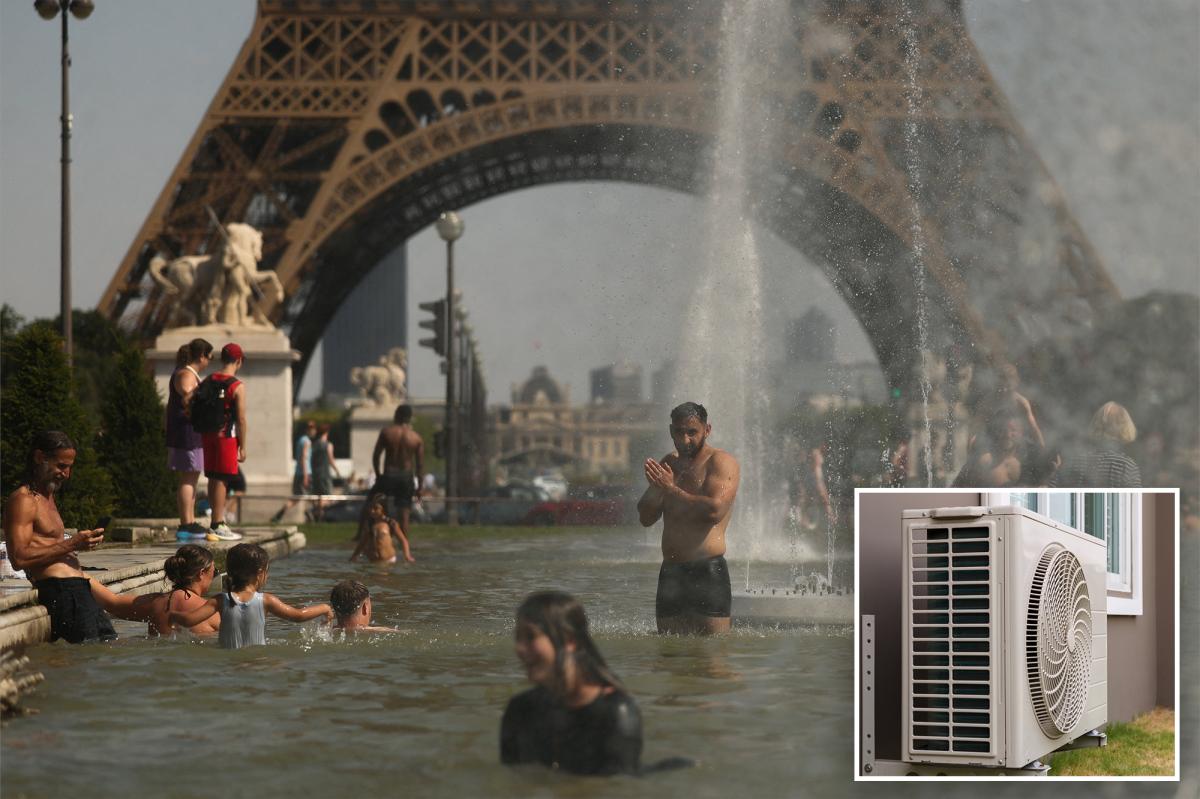
More than 16,000 people died across Europe in a single week during June’s record heatwave, yet officials in one of the hardest-hit regions still resist widespread air conditioning adoption.
In Wallonia, the French-speaking southern region of Belgium, 313 deaths were recorded on June 28 alone, surpassing the 245 daily deaths at the peak of COVID-19 in November 2020, according to mortality data analyzed by the outlet. Temperatures soared above 100 degrees Fahrenheit as the region recorded a death rate 77% higher than expected between mid-June and early July, leaving hospitals overrun and emergency operators struggling to answer calls that often took 10 minutes to get through.
“Air-conditioning can be appropriate in specific situations, particularly for vulnerable people or certain buildings,” a spokesperson for Wallonia’s housing and energy minister said, adding that their “long-term strategy is not based on its widespread use.”
Belgian doctor Toon Ceyssens, speaking to the Times, captured the cultural resistance bluntly: “They don’t want to be Americans.”
Around 16,000 excess deaths were recorded across Europe in just one week in late June, with Belgium, France, and Germany most affected, according to figures from the European Mortality Monitoring Network. The June 2026 heatwave has been described as the most extreme heat event ever experienced in Europe, with a preprint by Indiana University climate scientist Christopher Callahan estimating 20,390 heat-related deaths across the continent from June 22-28 alone.
“Each crisis is becoming increasingly severe. That’s what we’re failing to anticipate,” Wallonia’s regional health minister Yves Coppieters said.
The infrastructure crisis matched the human toll. Half of all emergency rooms in Wallonia’s hospitals have no air conditioning, according to Dr. Phillippe Devos, director general of a health care provider federation. In overcrowded health centers, many sick people were lined up in hallways to allow privacy for the dead.
Around 85% of the excess deaths in Wallonia were among those aged 65 or over, with low-income seniors who lived alone particularly at risk, according to official statistics. Geert Molenberghs, a professor at the Universities of Leuven and Hasselt, noted in Flemish media interviews that “there is, for example, a significant difference between Flanders and Wallonia, so there is an undeniable socio-economic aspect to all this,” explaining that “it is cooler in a large, detached house with some green space around it than in a small flat with too many people.”
“It’s a country that is considered cold, culturally. People think more about heating their house than cooling their house,” Gilles Vanvolsem, managing director of the Belgian Green Building Council, said.
The disparity in air conditioning adoption is stark. Just 20% of European homes have AC, compared to roughly 90% in the United States, and the figure drops to between 4-6% in France, Germany, and the UK. Daikin Central Europe noted in an April 2026 business press release that “just about 20% of homes in Europe have air conditioning, indicating substantial possibility for expansion.”
Ceyssens, the Belgian doctor, is pushing for a shift in mindset. “The mentality on air conditioning has to change,” he said, adding that many of his patients were reluctant to install AC over fears it would make them sick, spread germs, and harm the environment.
Belgian officials continue to hesitate over introducing air conditioning more broadly, warning it could overwhelm the power grid and heat up cities by pumping hot air into the streets. Authorities are instead looking at introducing more so-called cooling spaces and instituting policies to encourage housing renovation.
Reports said that Wallonia’s single-day death toll on June 28 had exceeded the region’s worst day of the COVID-19 pandemic, exposing how a continent unprepared for extreme heat was being ravaged by temperatures that broke records across multiple countries. The revelation that hospitals lacked basic cooling, that elderly patients died alone in overheated apartments, and that cultural resistance to American-style air conditioning persisted even as bodies accumulated, made the story impossible to ignore.
France confirmed on July 3 that the June heatwave killed 2,025 people above normal death rates, the highest heat-related excess mortality since the catastrophic 2003 summer that claimed more than 70,000 lives across Europe. The World Health Organization has warned that heat has killed an estimated 200,000 people across Europe over the past four years.
Belgium’s federal data showed 1,747 more deaths than usual during the June 18 to July 1 heatwave period, with Wallonia’s excess mortality rate hitting 76% compared to 31.4% in Flanders and 60.9% in Brussels.
Wallonia officials are scheduled to present updated heat preparedness plans to the regional parliament in September.