

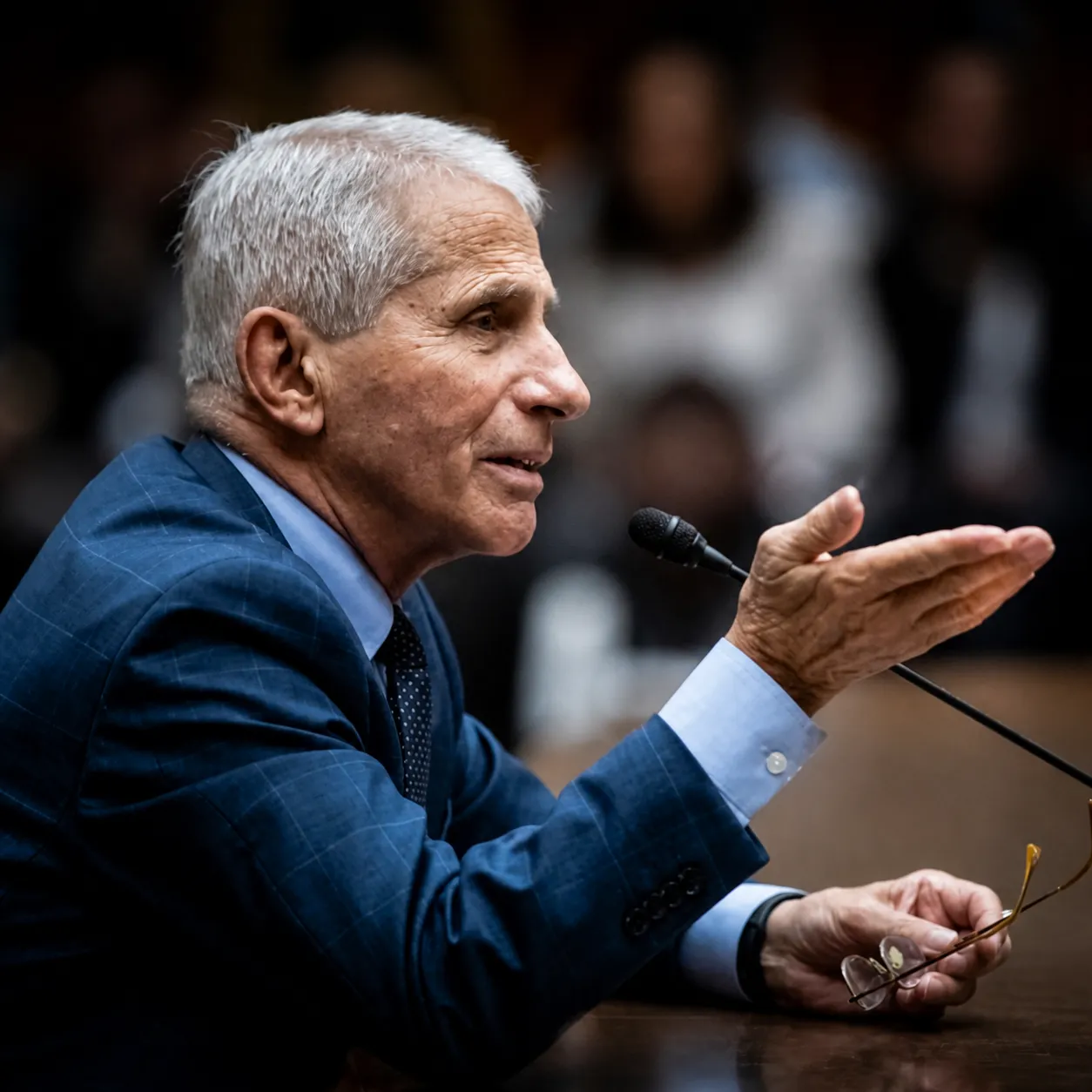
Dr. Anthony Fauci, the U.S. Scientist who helped lead the nation’s COVID-19 pandemic response, faced off with Senate Republicans on Wednesday as part of continuing investigations into the origins of the coronavirus, capping years of contentious clashes over his role in the government’s pandemic response.
Fauci appeared before the Senate Homeland Security and Governmental Affairs Committee after being subpoenaed by the committee’s chair, Sen. Rand Paul of Kentucky, who has spent years accusing the former infectious disease expert of misleading the public and Congress about how the pandemic began. The hearing represented a return to Capitol Hill for Fauci, who left his position as director of the National Institute of Allergy and Infectious Diseases at the end of 2022.
The hearing came just days after Paul released more than 1,100 pages of Fauci’s personal diary entries covering December 2019 through December 2022. Paul and his allies argue the diary reveals contradictions between what Fauci wrote privately and what he told the country publicly about the virus’s origins. On the social media platform X, Paul wrote that Fauci’s private writings and public statements were “two different stories.”
Paul has long pushed the theory that the coronavirus emerged from a laboratory leak at the Wuhan Institute of Virology in China rather than spilling over naturally from animals to humans. For years, he has also accused Fauci of approving controversial gain-of-function research—studies that can enhance how dangerous a pathogen is—at labs in China, and of covering up that involvement.
The diary entries, which Health and Human Services Secretary Robert F. Kennedy Jr. Said were found on government servers after an eight-month search, document Fauci’s daily activities during the pandemic’s earliest days. Some entries describe early scientific uncertainty about the virus’s origins. In one February 1, 2020 entry, Fauci documented a conference call with leading virologists in which there was disagreement about whether the virus emerged naturally. Of 11 scientists on that call, only two believed the virus originated naturally, while others expressed uncertainty about the possibility of laboratory creation.
Fauci has long maintained that scientific evidence points to a spillover event, whereby the virus jumped from animals to humans. He has called accusations that he influenced scientists’ conclusions through financial incentives “absolutely false and simply preposterous.” In his diary entries released this week, Fauci has repeatedly denied Paul’s allegations about gain-of-function research and cover-ups.
The decades-long career scientist’s attorneys have previously dismissed Paul’s accusations as “absolutely baseless” and described them as part of an “obsessive and groundless vendetta.” They also noted that Paul has repeatedly called publicly for Fauci to be prosecuted and jailed, raising concerns about the context of the subpoena.
The contentious relationship between Paul and Fauci extends back years, with the two clashing repeatedly during heated Senate hearings when Fauci was leading the country’s pandemic response. According to diary entries released this week, Fauci wrote in 2022 that when Republicans failed to take control of the Senate in the midterm elections, Paul would “not have the opportunity to harass me with senate oversight hearings.” He also described Paul in earlier entries as “stupid” for his questioning during previous hearings.
The political divide surrounding Fauci has remained intense long after the pandemic. He became a target of criticism from those who opposed mask mandates and lockdown policies, with some calling for his prosecution. The situation became serious enough that former President Joe Biden issued a preemptive pardon to Fauci in January 2025, just before leaving office. Biden said he was protecting Fauci from threats of “unjustified and politically motivated prosecutions” by the incoming Trump administration.
In his response to the pardon, Fauci maintained his innocence while acknowledging the toll of the threats. “Let me be perfectly clear: I have committed no crime and there are no possible grounds for any allegation or threat of criminal investigation or prosecution of me,” he said in a statement. However, he added that the threats themselves “create immeasurable and intolerable distress for me and my family.”
Scientists have largely rallied to Fauci’s defense, noting that his diary entries reflect the genuine uncertainty scientists faced in the pandemic’s earliest days rather than evidence of misconduct. Some experts have suggested that Fauci may have been more candid with scientific colleagues in private as they raced to understand the novel virus than he was in public statements, where he bore responsibility for reassuring a panicked population.
The hearing follows the long-running debate about COVID-19’s origins. While the current scientific consensus suggests the virus likely originated naturally, with genetic data pointing to animal-to-human transmission at a Wuhan market, the intelligence community remains divided. The FBI has assessed the coronavirus most likely emerged from a lab incident in Wuhan, while the CIA issued a new assessment in January 2025 favoring the lab leak hypothesis, though it said the finding was made with “low confidence.”
Republicans’ continued questioning of Fauci is expected to focus on his interactions with scientists regarding the virus’s origin, his role in approving research funding, and allegations that he and other officials concealed information from the public and Congress. Paul has signaled he intends to use the hearing to press Fauci on his accounts of early pandemic-related decisions and his communications with the scientific community.
The hearing underscored the deeply political landscape that has surrounded the pandemic response even years after it receded from the headlines. For Fauci, now in his eighties and retired from government service, the continued scrutiny represents an ongoing consequence of his prominent role during one of the nation’s most divisive recent events.