

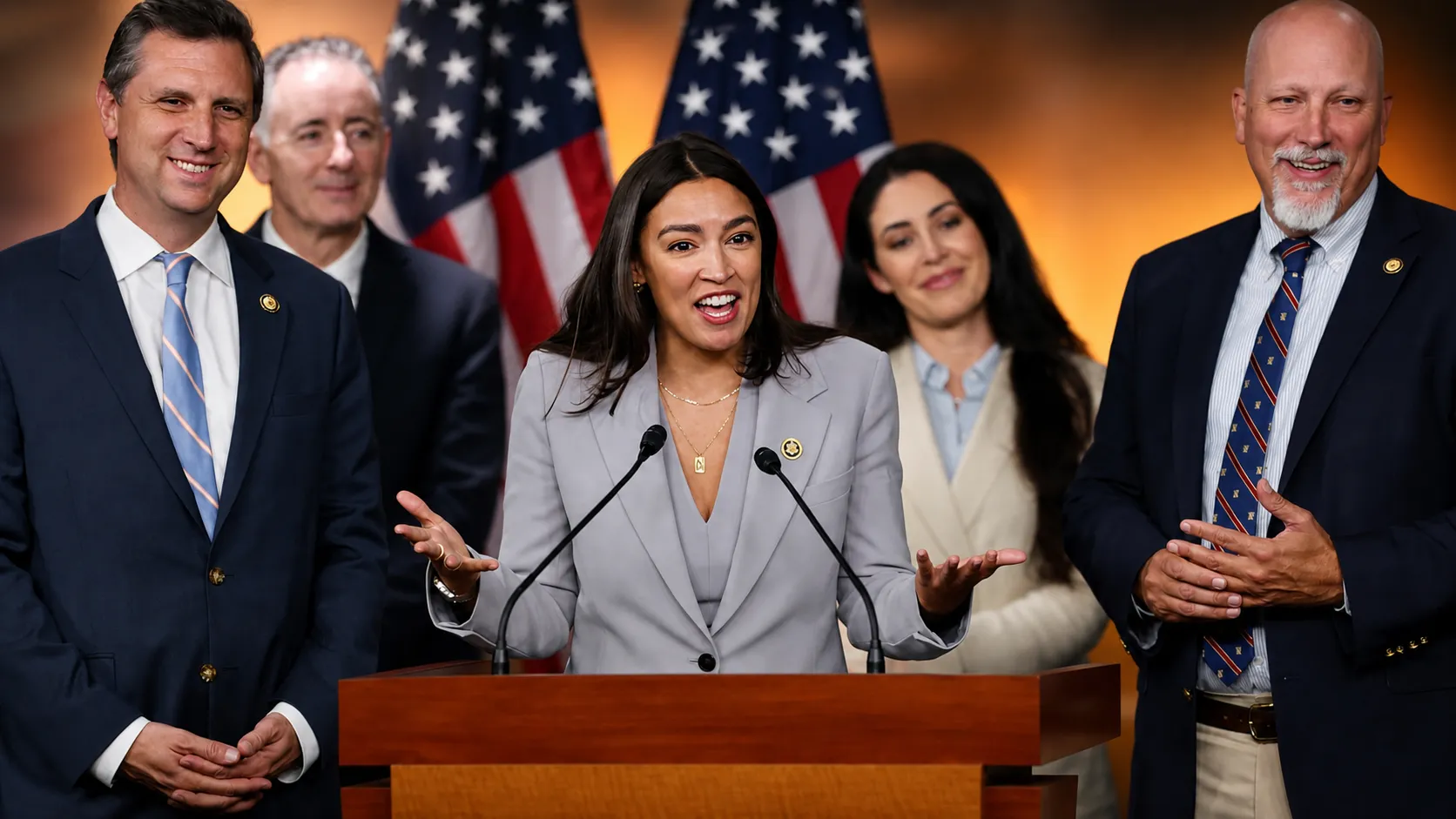
The U.S. House of Representatives passed legislation Wednesday that would bar members of Congress from purchasing individual stocks while in office, marking the first full chamber vote on restricting lawmakers’ ability to trade individual company shares. The Stop Insider Trading Act passed on a 232-198 vote, with nearly all Republicans and at least 13 Democrats voting in favor.
The vote came after years of stalled efforts to address a practice that has drawn intense scrutiny from voters and ethics advocates concerned about potential conflicts of interest. While there is broad public support for restricting congressional stock trading—with recent polling showing 86 percent of Americans backing such a ban—the bill itself has become a focal point in the 2026 election cycle, with candidates on both sides airing campaign advertisements about the issue.
The legislation, introduced by Representative Bryan Steil of Wisconsin and leading House Republicans, prohibits members of Congress, their spouses, and dependent children from acquiring shares in publicly traded companies. However, the measure does not require lawmakers to divest existing stock holdings. Members would be allowed to sell portions of their current portfolios provided they publicly announce their intention to do so at least seven days in advance. The bill would also increase penalties for members who fail to properly disclose stock sales, assessing fines of $2,000 or ten percent of the transaction value, whichever is greater.
The passage of this legislation represents a significant moment in a debate that has persisted for more than a decade. An investigation by the outlet found that from 2019 to 2021, 18 percent of congressional members traded stocks in sectors related to the work of the committees they served on. Despite a 2012 law—the STOCK Act—that already makes insider trading illegal for members of Congress and requires disclosure of trades within 45 days, critics have long argued that the law contains weak penalties that are rarely enforced. No member of Congress has ever been prosecuted for insider trading under that law.
The latest push for restrictions on congressional stock trading has emerged as a central campaign issue heading into the midterm elections on November 3. According to an analysis by AdImpact, nine candidates and outside groups have aired broadcast advertisements focused on stock trading in 2026, with six spots from Democrats and three from Republicans. In Ohio, Democratic Senator Sherrod Brown launched a television advertisement noting that last year members of Congress made more than $635 million in stock trades, calling for a ban on such activity.
Supporters argue that restricting stock trading is essential to restoring public trust in government and preventing lawmakers from using non-public information derived from their positions to profit in the markets. Republican Representatives Jeff Hurd, Jeff Crank, and Gabe Evans cited public confidence as a key motivation. “Public confidence and trust in Congress is at a near all-time low, and this is an important way for members of Congress to show that we’re not using information to benefit ourselves personally,” Hurd said.
However, the bill has faced significant criticism from Democrats and even some members of a bipartisan coalition that had previously pushed for a more comprehensive ban on stock ownership. Representative Seth Magaziner of Rhode Island, who is part of a bipartisan group that has advocated for stronger restrictions, told media outlets that the measure falls short. “It’s a stock trading ban that still allows stock trading. It’s a weak bill,” Magaziner said.

The disagreement centers on the bill’s scope. A more comprehensive bipartisan proposal introduced by Representatives Chip Roy and Seth Magaziner earlier would have required current members to divest from individual stocks within 180 days of the bill becoming law. That measure, known as the Restore Trust in Congress Act, has 126 co-sponsors in the House and has been backed by a bipartisan coalition that includes Representatives Alexandria Ocasio-Cortez and Brian Fitzpatrick.
House Republicans significantly complicated the bill’s path forward by attaching a voter identification requirement to the stock trading measure. The addition links the legislation to the SAVE America Act, which President Donald Trump has been pressing Congress to pass. The voter ID provision requires proof of citizenship to register to vote and mandatory voter identification to cast a ballot. This attachment has made Democratic support for the package far less likely, as many Democrats oppose stricter voting requirements.
The bill now faces an uncertain future in the Senate. If it advances to the upper chamber, where most legislation requires 60 votes to overcome a filibuster, its prospects appear dim. Senate Republicans have introduced a companion bill, and Senator Pete Ricketts of Nebraska, who is sponsoring the Stop Insider Trading Act in the Senate, expressed optimism about its chances. However, the Senate has only about ten weeks of session time remaining before the November midterm elections, leaving limited time for the chamber to take action.
Congressional stock trading has drawn renewed scrutiny in recent months. President Donald Trump’s trading disclosures showed more than 3,700 transactions in the first three months of 2026, including purchases of Nvidia and Axon stock ahead of major government announcements involving those companies. Vice President JD Vance stated at the time that Trump’s wealth advisors manage his money independently and that the proper response was to outlaw such trading entirely.
The effort to ban or restrict congressional stock trading has become one of the rare issues with genuine bipartisan appeal among voters and lawmakers alike, even as the details of any eventual legislation remain subject to intense political disagreement.