

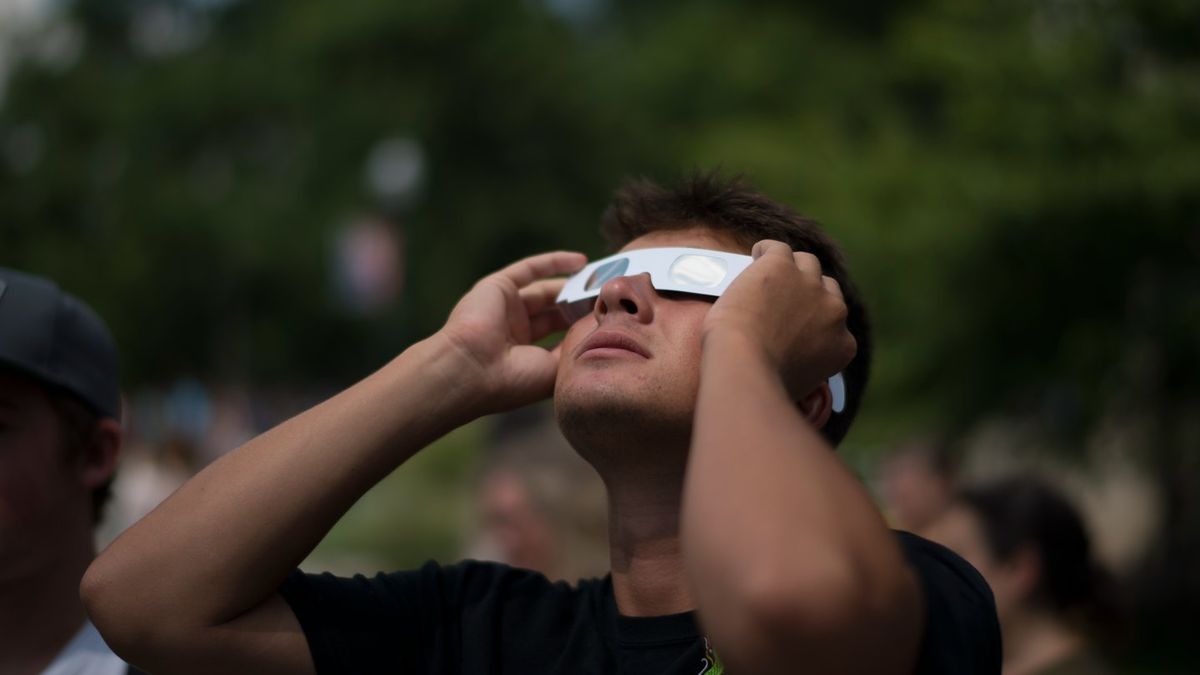
People across the Northern Hemisphere will be able to catch Wednesday’s solar eclipse, and anyone who missed out on eclipse glasses can still follow it safely by viewing it indirectly instead of looking at the Sun.
Demand for specialist eclipse glasses has surged ahead of the event, leaving many shops and online retailers with limited or no stock. The Royal Observatory Greenwich has reported selling out amid unusually high demand, and pharmacies, opticians and retailers across Europe are struggling to keep protective glasses in stock as the eclipse approaches. Eye specialists have warned the public against buying unverified products that simply look like proper eclipse glasses, emphasizing that certified solar viewers must meet the ISO 12312-2 safety standard.
There are several easy ways to safely view the eclipse with ordinary items at home, including a basic pinhole projector made from card, a kitchen colander, or a simple viewer built from an empty cereal box.
On August 12, the eclipse will be total along a narrow track that passes over Greenland, Iceland and Spain, with a small part of Portugal also falling inside the path of totality. At its longest, near the centerline over the North Atlantic between Greenland and Iceland, the total part of the eclipse will last 2 minutes and 18 seconds.
A much larger area will get a partial eclipse, including most of Europe, the UK and Ireland, and parts of northern North America such as sections of the US and most of Canada. In the UK, viewers will see a particularly large portion of the Sun covered, with around 90 percent of the Sun obscured by the Moon in some areas, making this nearly as close to a total eclipse as has been seen from the British Isles since 1999.
If you have not bought eclipse glasses in time, these homemade viewing methods offer a safe alternative because they project the Sun’s image onto another surface rather than requiring you to stare at it.
The simplest option is a pinhole projector, which only needs two pieces of card or paper and something sharp enough to make a tiny opening.
Make a small hole in one piece, stand with your back to the Sun, and let the sunlight pass through onto a second sheet. Instead of looking upward, you watch the projected image on the paper, and as the Moon moves across the Sun, that image changes shape.
The UK Health Security Agency includes pinhole projection among the safe ways to watch an eclipse without specialist equipment.
A colander from the kitchen can work in much the same way. Hold it so sunlight passes through the holes and falls onto paper or another light surface below.
Because each opening acts like its own tiny pinhole, you will see multiple small images of the Sun at once, all of which change as the eclipse progresses.
David Jones, consultant ophthalmologist at the Royal Cornwall Hospitals Trust, says this is his preferred way to experience an eclipse. “If you hold the colander to the Sun and you look away from the Sun, protecting your eyes, you can make not just one picture of the Sun but a hundred all at once.”
For a more enclosed setup, an empty cereal box can be turned into a viewing chamber. Put white paper in the bottom, cut openings in the top, cover one opening with aluminum foil, and then make a tiny hole in the foil.
With the Sun behind you, look through the other opening and line the pinhole up with the sunlight. The Sun’s image will appear on the paper inside, and the box helps block excess light so the projection is easier to see.
While the total eclipse is limited to Greenland, Iceland, Spain and a small area of Portugal, the partial phase will be visible across a far broader area that includes parts of Europe, northern Africa and northern North America.
In the UK, viewers will see only a partial eclipse, with the Sun relatively low in the western sky during the event.
Whatever method you choose, the key rule is the same: do not look directly at the Sun. Even when most of the Sun is covered during a partial eclipse, the remaining crescent still carries full surface brightness and is never safe to look at with the naked eye. Ordinary sunglasses are not a safe substitute for certified eclipse glasses, and NASA has also warned that an unprotected phone camera pointed at the Sun can suffer sensor damage. Looking directly at the Sun without proper eye protection can damage the retina and lead to solar retinopathy, an injury to the light-sensitive tissue at the back of the eye, with symptoms including blurred or distorted vision, blind or dark spots, and changes in color perception.
Indirect projection avoids that danger and still lets you track the eclipse safely.
NASA says a homemade pinhole projector is easy to put together at home. Cut a one-inch to two-inch square or rectangular hole in the middle of one piece of card stock, tape aluminum foil over it, then turn it over and use a pin, paper clip, or pencil to make a small hole in the foil.
Place the second piece of card stock on the ground and hold the foil-covered piece above it with the foil facing up. Stand with the Sun behind you and watch the projected image appear on the card below.
The farther away you hold your camera, the bigger your projected image will be.
Even with these simple techniques, one warning still matters most: never look directly at the Sun without equipment that’s specifically designed for looking at the Sun. Sunglasses, binoculars, and telescopes do not count as proper protection.