


A leading Turkish forensic pathologist is now challenging the official cause of death for a Canadian medical student who died during her graduation trip to Istanbul last June.
Bérengère Deveaux-Cattino, 24, of Montreal, fell violently ill and died on June 17, while celebrating her medical school graduation with friends in Turkey’s largest city. Her traveling companions had also become sick after the group shared a meal of chicken casserole, Turkish tea and baklava at their hotel, according to Laurie, a friend who used a pseudonym to protect her identity.
“Then I started feeling unwell,” Laurie said, “and suddenly we were taking turns running to the bathroom to vomit until we realized that whatever it was, it wasn’t just going to pass.”
During the ordeal, Deveaux-Cattino FaceTimed her older sister Éléonore, warning that things were deteriorating rapidly in a Turkish hospital.
“I thought: ‘This isn’t normal. Something’s off. This is going to be bad news,'” Éléonore Deveaux-Cattino said in an interview with CBC. “She says, ‘Élo, we’re in the hospital in Istanbul, and things aren’t going well. I’ve been told to contact the family.'”
Éléonore and their father, Henri Cattino, rushed to book flights to Istanbul but received confirmation of Bérengère’s death while waiting for a connecting flight in Paris.
“I said: ‘Please, can you tell me if my sister has died?'” Éléonore recalled. “And she said: ‘I’m very sorry, Éléonore, but your sister is dead.'”

The family repatriated Bérengère’s body and pressed for answers, but buried her with her cause of death unresolved. Months later, in November 2025, a parallel tragedy unfolded just blocks from where Deveaux-Cattino had stayed. A Turkish-German family of four, the Böceks, died within three days of their own Istanbul trip after investigators determined aluminum phosphide — a highly toxic agricultural pesticide nicknamed “the bomb” — had been used for bedbug fumigation in an adjacent hotel room. The pellet-form chemical releases deadly phosphine gas when exposed to air, capable of killing every living thing in a sealed space within 72 hours. Though illegal in urban areas, the method persists in Istanbul due to a severe bedbug crisis, with desperate property owners ignoring warnings that neighbors could die.

The Böcek case prompted the Deveaux-Cattinos to scrutinize Bérengère’s Turkish autopsy report more closely. The document ultimately concluded food poisoning killed her, but Quebec’s coroner found no supporting evidence.
“The coroner here ran some tests, and she couldn’t confirm that food poisoning was the cause of death because, usually, there are signs of intestinal irritation,” Éléonore Deveaux-Cattino said. “There were none in my sister’s case.”
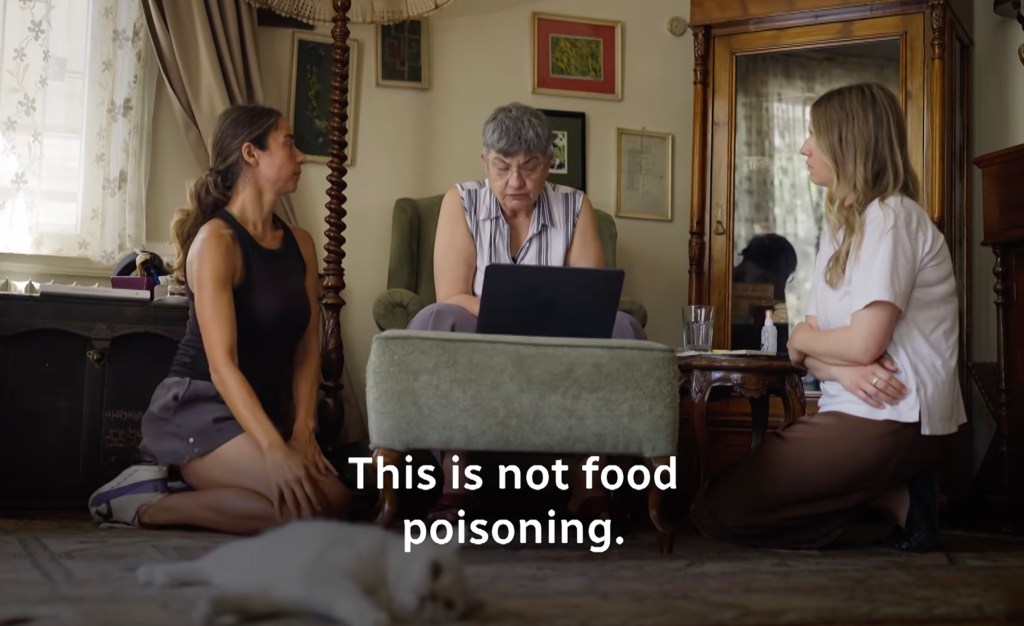
Sebnem Korur Fincancıs, a prominent forensic pathologist in Turkey, reviewed the same autopsy report and reached a starkly different conclusion than Istanbul authorities.

“This is not food poisoning,” Fincancıs said. “I don’t think that this is food poisoning because there is no story of diarrhea, only throwing up. Rather, it is the pesticide poisoning.”
Fincancıs identified metabolic acidosis in the report — increased acidity in the body that she described as a signature finding in phosphine gas cases.
“There is the metabolic acidosis, which also indicates the pesticide intoxication,” she continued. “It is one of the main findings of these kinds of cases.”
“With all these misdiagnoses, we have to consider the situation.”
Investigative reporting by CBC and freelance Turkish journalist Ayse Adanali uncovered additional red flags. The Seven Days Hotel, where Deveaux-Cattino and her friends lodged, showed evidence of a possible bedbug infestation — including in the room next door to hers. Hotel manager Bahattin Demir told reporters that an exterminator sprayed monthly but denied aluminum phosphide was used. The hotel’s contractor, Wolves, also denied deploying the chemical. Yet in an undercover call arranged by journalists, a Wolves employee described a bedbug protocol requiring rooms to be sealed for 72 hours with no living thing permitted entry.
“For 72 hours, nobody goes in, the doors are locked and nothing living enters,” the employee said.
The pesticide has killed Canadians before. In 2012, Quebec sisters Audrey and Noémi Bélanger died in Thailand from aluminum phosphide exposure. Since 2023, Turkey has recorded 30 phosphine poisoning cases and roughly a dozen related deaths, according to the investigation.
The Böcek family’s deaths resulted in criminal convictions: the pest control company owners received 18-year prison sentences, while the hotel owners and staff were sentenced to approximately 12 to 13 years. No such accountability has come in Deveaux-Cattino’s case, and Turkish authorities have not publicly revisited her cause of death.
Éléonore Deveaux-Cattino has vowed to keep pressing for the truth about what killed her sister.
“My sister is younger than me. I’d never imagined a life without her. We used to be two against the world … now I’m all alone,” she said. “But I’m stubborn. And since she can no longer speak, I’ll speak for her. I’ll never let her go.”
The Quebec coroner’s office has not announced whether it will formally challenge the Turkish autopsy findings.