

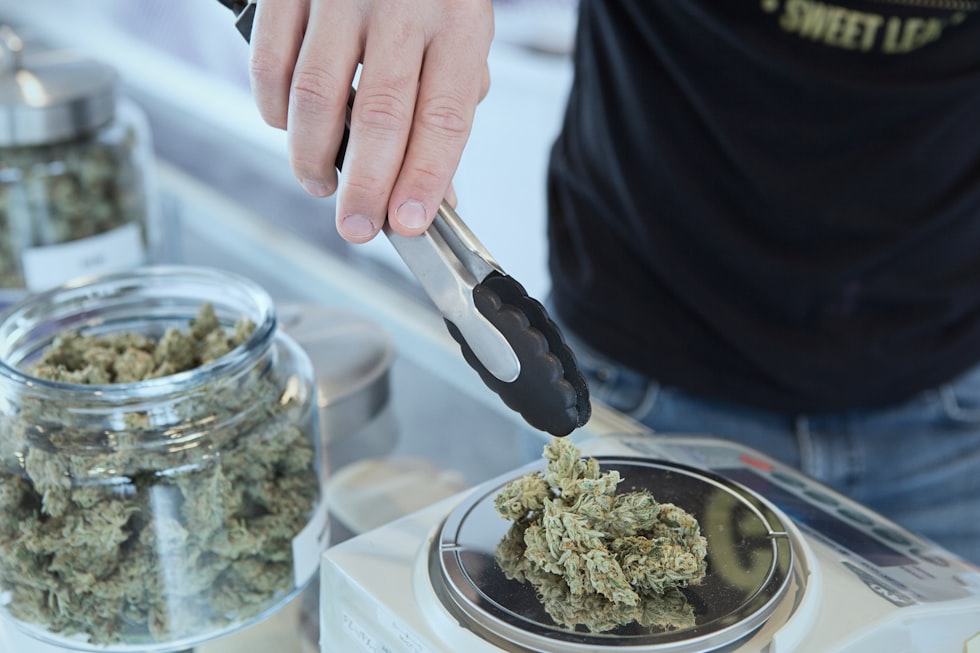
Gov. Kathy Hochul signed legislation on Aug. 6 to clarify that cannabis microbusinesses can sell their products at farmer’s markets and fully participate in other approved community events.
The law clarifies that cannabis microbusinesses can sell their products at farmer’s markets and fully participate in other approved community events.

The new law clears up ambiguity in March 2025 legislation that Hochul signed, which established Cannabis Showcase Events, allowing licensed dispensaries to partner with licensed cultivators and processors to showcase and sell their cannabis products outside the normal retail setting, at places such as pop-up events and public markets.
Previously, the rules were unclear.
Under previous law, microbusiness licensees were only authorized to sell their own products at the events.
The law that Hochul signed into effect on Thursday establishes that vertically integrated microbusinesses don’t need to partner with standalone cultivators or processors to participate in these events.
“This new law gives licensed microbusinesses and dispensaries a real chance to succeed in New York’s legal cannabis market. By opening the door for legal operators to sell at approved community events and farmer’s markets, we are putting small entrepreneurs on a level playing field, expanding consumer access to safer, regulated products and strengthening one of New York’s fastest-growing industries,” the governor said.
After recording roughly $900 million in adult-use sales in 2024, New York’s licensed dispensaries reported nearly $1.7 billion in sales in 2025 and are on pace to eclipse that mark in 2026.
The market’s growth matters.
“But the strength of this market lies in the businesses operating across the supply chain,” OCM Executive Director John Kagia said.
Democratic State Senator Michelle Hinchey introduced the bill in her chamber on April 30, and Democratic Assemblymember Donna Lupardo introduced the Assembly version.
Hinchey explained the urgency.
“Cannabis microbusinesses are often small farms without big marketing budgets or easy access to retail markets. Showcase events, like farm markets, give these small businesses a perfect way to reach consumers with their homegrown products. With summer here and New Yorkers excited to shop outside, it’s critical that cannabis microbusinesses can participate in showcase events alongside retailers and other licensees—and our legislation makes that possible,” she said.
Lupardo echoed the sentiment.
“The bill ensures that NY’s cannabis microbusinesses can participate in Showcase Events occurring across the state. I’d like to thank the Governor for recognizing the importance of supporting these small businesses by signing our legislation today. They need every competitive advantage in order to market their products, build brand awareness and develop long-term community connections,” she said.
The Cannabis Farmers Alliance celebrated the win.
“The Cannabis Farmer’s Alliance is thankful to the Governor for signing this important fix to the showcase events statute and to the Office of Cannabis Management for its critical guidance and support. Likewise we are grateful for the support of the legislative sponsors, Senator Michelle Hinchey and Assemblywoman Donna Lupardo, who have been tireless in their advocacy for cannabis farmers,” President Joseph Calderone said.
NY Small Farma, a nonprofit organization for independent cannabis farmers, also praised the move.
“NY Small Farma is grateful to the Agriculture Committee Chairs of the Senate and Assembly for sponsoring our showcase bill, to the Office of Cannabis Management for its willingness to work with us to strengthen the language, and to Governor Hochul for swiftly signing this pivotal legislation into law. This collaborative effort demonstrates New York State leadership’s commitment to ensuring that small-scale growers can build economically viable businesses, connect directly with consumers, and fully realize the seed-to-sale model envisioned under the microbusiness license tier. NY Small Farma looks forward to continuing this collaborative partnership as this important legislation is implemented so that all microbusinesses can have meaningful market access,” President Nicole Ricci said.
The law took immediate effect.
Senate Bill 10113, now Chapter 207 of the Laws of 2026, took effect immediately after being signed on August 6. The measure passed the Senate 47 to 13 and the Assembly 88 to 53 before being delivered to Hochul on July 31.
Licensed, local cannabis vendors can now sell state-approved products at outdoor farmer’s markets. Licensed microbusinesses and dispensaries can apply for Cannabis Showcase Event permits to set up pop-up shops.

New York faced a crisis of stranded inventory.
Hepworth Farms on the banks of the Hudson River in Ulster County was among 200 marijuana farmers questioning whether they could continue. “There are farmers that hold licenses that are questioning whether they can or cannot because they didn’t sell last year’s crop,” said Amy Hepworth, of the 105-year-old farm. “We have finished product that’s ready for distribution.”
Less than 12 retail stores were fully operational, and New York farmers were sitting on 300,000 lbs. Of unsold marijuana.
“It’s the better alternative to the illegal bodegas, because it keeps the cultivators in the game that put their skin in the game,” said Jason Minard, general counsel to Hepworth Farms. “But for the time being, we need an immediate emergency relief farmers’ market initiative to allow the farmer to survive this season.”
Local municipalities are responsible for authorizing and approving these events in coordination with the New York Office of Cannabis Management (OCM).
The law’s success will depend on how quickly municipalities and the OCM coordinate.
New York marijuana officials have announced that they have begun accepting applications from licensed dispensaries that want to host temporary cannabis farmers’ markets and pop-up events.
“Cannabis Showcase Events expand opportunity within New York’s regulated market in a thoughtful and deliberate way while keeping the guardrails firmly in place. These events allow licensed retailers, cultivators, and processors to meet consumers where they are, at community markets and pop-ups—while maintaining strict safety standards, age restrictions, and local oversight. This is about creating flexibility for businesses while preserving public health safeguards and local authority,” John Kagia, OCM’s acting executive director, said.
Cannabis Showcase Event regulations include the following prohibited activities: Persons under the age of 21 must not be allowed access to the CSE sales area, and no cannabis sales can occur to persons under 21. Consumption of cannabis within the CSE area is strictly prohibited, and permit holders must have conspicuous signage around the event area announcing this prohibition.