

The United Nations General Assembly endorsed a new world map Friday after a campaign led by African nations, with the United States standing alone in opposition.
The resolution passed with 164 member states voting in favor. Togo, 57, sponsored the measure with backing from the African Union. Only the U.S. Voted against it, while Serbia, Estonia, Georgia, Lithuania, Moldova and Ukraine abstained.
“Maps shape our understanding of the world,” Togo’s Foreign Minister Robert Dussey said before the vote, according to the UN’s own report. “They guide education, nourish the imagination, and influence collective perceptions.”
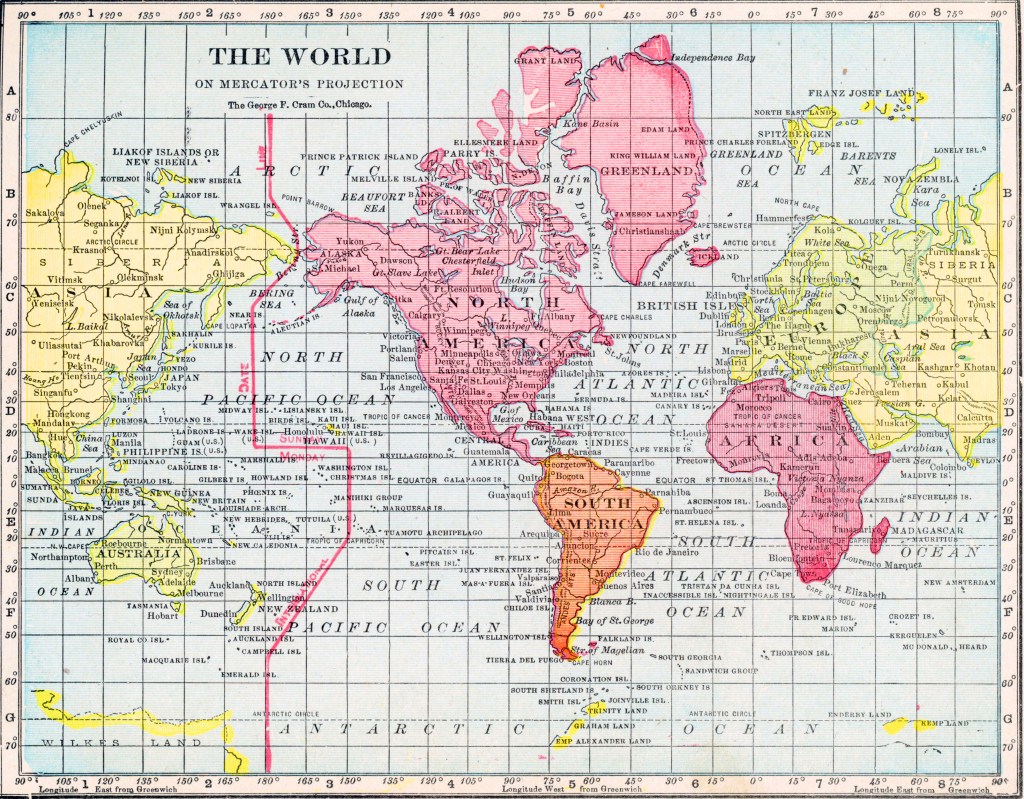
The vote encourages governments and institutions worldwide to replace the traditional Mercator map with the Equal Earth projection. The Mercator version, designed by Flemish cartographer Gerardus Mercator in the 16th Century to aid European navigators at sea, has distorted perceptions for centuries by enlarging regions near the poles while shrinking landmasses closer to the equator.
Under the Mercator projection, Greenland and Africa appear roughly the same size. The Equal Earth projection, developed in 2018, shows continents in their true proportions — revealing that Africa is actually 14 times larger than Greenland.
Mark Monmonier, a Syracuse University professor of geography, dismissed the old map’s broader utility. “Outside of that very narrow navigation application,” he said, “there is no point in using it.”
The resolution does not ban the Mercator projection or mandate its replacement. It merely encourages adoption of the Equal Earth alternative, the UN noted in its report.
Africa No Filter, a lead advocacy group in the campaign, celebrated the outcome. The organization called for “accurate maps in schools, textbooks, newsrooms, businesses and on the digital platforms billions of people use every day.”
French Foreign Minister Jean-Noël Barrot voiced support on X following the vote. “Changing the map obviously doesn’t change the world,” he wrote. “But correcting a representation that distorts it is already an act of truth.”
The campaign for map reform gained momentum through African countries and allied advocacy groups pushing to correct what they view as a persistent visual misrepresentation rooted in colonial-era cartography. The Mercator projection’s distortion particularly affects Africa and South America, which appear far smaller relative to northern landmasses than they actually are.
The 2018 Equal Earth projection follows the Earth’s curvature to display countries’ true size relative to one another, addressing criticisms that the traditional map perpetuates skewed geographical understanding across education, media and public consciousness.
The UN General Assembly will reconvene for its next regular session in September in New York.