

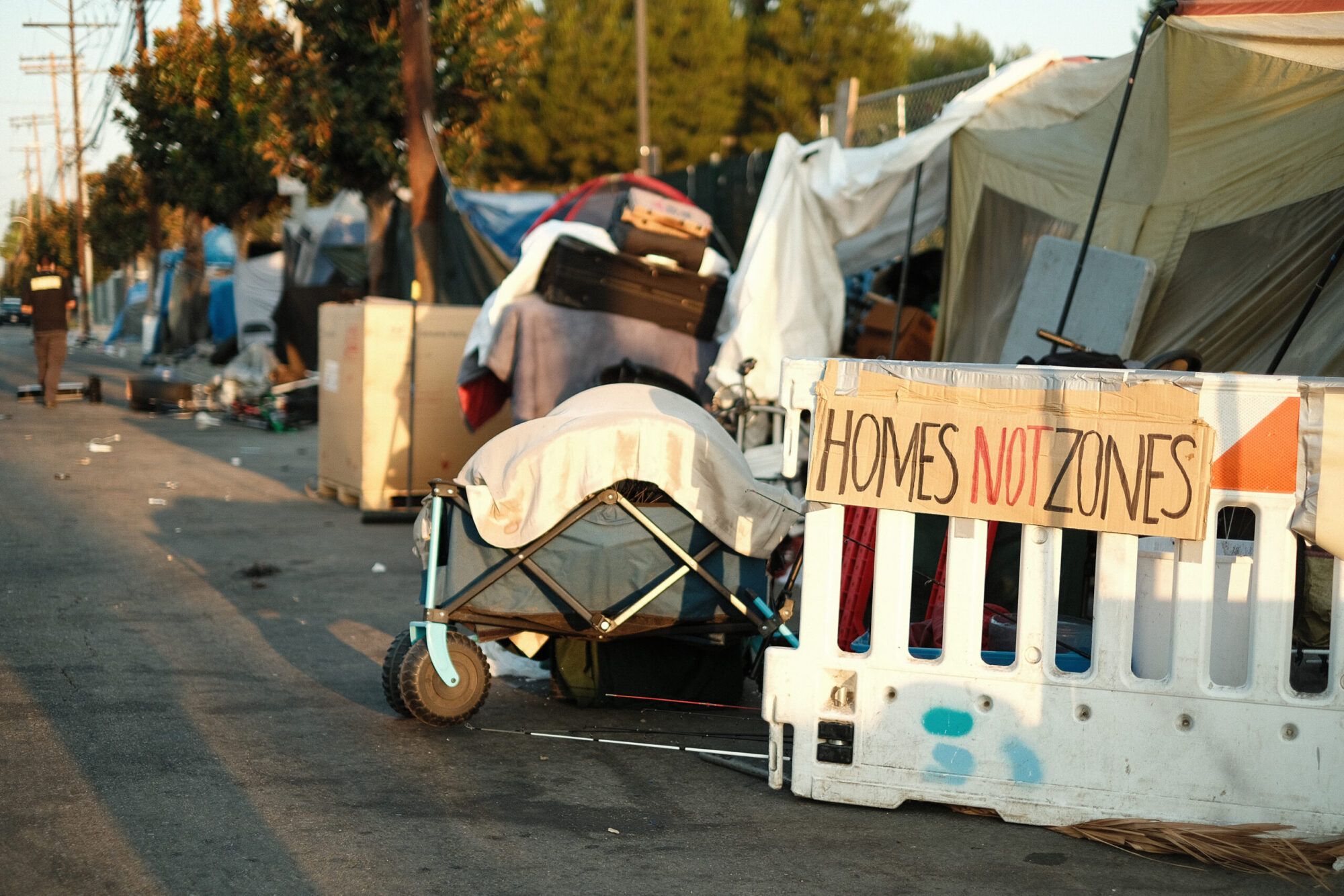
Van Nuys Boulevard, the once-iconic strip that drew thousands of cruising teens in the 1970s, has descended into a drug-riddled wasteland of homeless encampments and shuttered storefronts, according to a recent investigation.
The boulevard between Sherman Way and Victory Boulevard now features makeshift tents blocking storefront entrances, crack pipes and needles scattered on sidewalks, and discarded bottles of whiskey piled in front of encampments.
One business at the location was forced to move its customer entrance to an alley on the west side of the boulevard because homeless tents completely blocked the original Van Nuys entrance. Trash, clothes and even jars of open mayonnaise littered the ground, while broken metal spoons and lighters—signs of heroin and crack use—lay near bus stops.
George Barak, originally from Syria, was working his second day as a cashier at the 99-cent store when he spoke about the transformation.
“It’s so sad, so sad. We are in California, the best state in the United States, right?” he said.
Barak noted the frustration of trying to operate a business on the once-beloved boulevard. “I hope the city can help a little bit to clean up the thing,” he said.
The discount store where Barak works moved its entrance to survive the encampment crisis.
Most of the stores along the famed blocks are boarded up, but the businesses brave enough to open such as the ones Barak and Saxenian work at said they never know what to expect one day to the next.
Aziz Saxenian, a Los Angeles native and dental assistant at another struggling business on the boulevard, shared similar frustrations.
“They settle in front of our businesses. Customers say, ‘Oh, can’t you get rid of them?'”
Saxenian explained that her boss purchased the dental office just six months ago with hopes for improvement. Yet the outlook remains bleak given the deteriorating conditions surrounding the practice.
The dental assistant expressed her disappointment with the city’s response.
“We’re hoping our taxes would go somewhere where this situation wouldn’t exist on the streets. It’s very sad. We would love the city to do something about it.”
Rick McCloskey, who was a teenager cruising Van Nuys in the mid-1970s, documented that era with his camera. His photographs appear in the book “Van Nuys Boulevard 1972,” which captures a starkly different time.
The images McCloskey captured show smiling teens and vibrant storefronts as a movie theater marquee displayed the newly released “Godfather” film while youth socialized freely on the street.
“That Boulevard was our meeting place, that’s what it was for,” McCloskey told the outlet.
Teens came from across Southern California to cruise the street in their customized hot rods and lowriders. The boulevard had become a mecca for youth car culture, drawing visitors from as far as Santa Barbara and Orange County.
Hollywood recognized the street’s cultural significance by producing a film about the cruising phenomenon, simply called “Van Nuys Boulevard.” The road’s robust social scene and youthful energy made it legendary across the region during the 1970s.
McCloskey expressed shock at how far the boulevard has fallen.
“The only tension was if boys were fighting over a girl. There was no homelessness and no crime. There was no resemblance to what it was. It has fallen very far, it was depressing. I don’t have a desire to go back.”
The photographer’s memories stand in stark contrast to today’s reality, where the same street is now synonymous with open drug use and urban decay rather than youthful celebration.
District 6 Council member Imelda Padilla, who represents the Van Nuys Boulevard area, did not respond to a request for comment about the boulevard’s condition and the businesses struggling with the encampment crisis.
Local workers employed by the city have been forced to use leaf blowers to disperse the massive amounts of garbage left behind by encampments as the situation continues to worsen.