

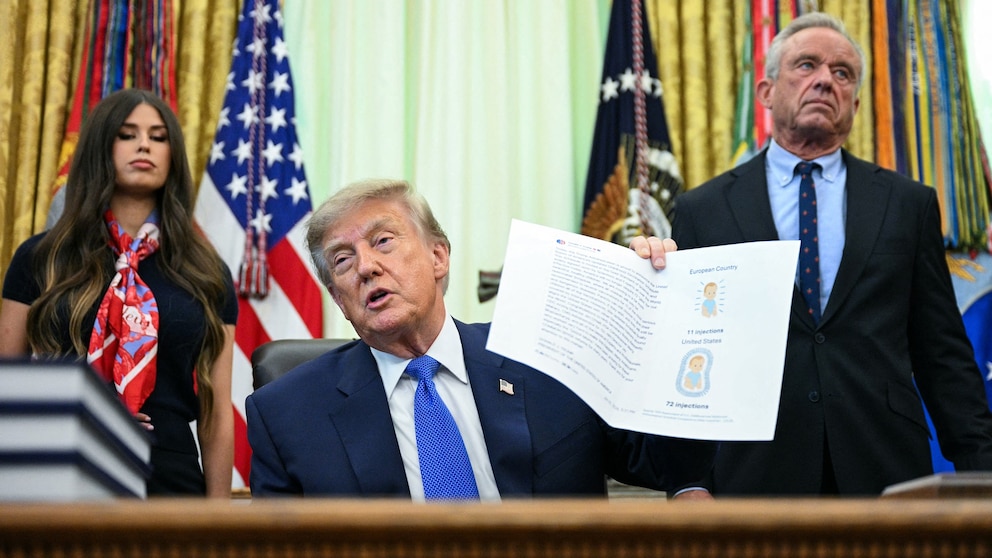
President Trump signed an executive order on Monday that calls for reducing the number of universally recommended childhood vaccines and splitting the measles, mumps, and rubella (MMR) vaccine into three separate shots, as he revived his long-held claims linking vaccines to autism.
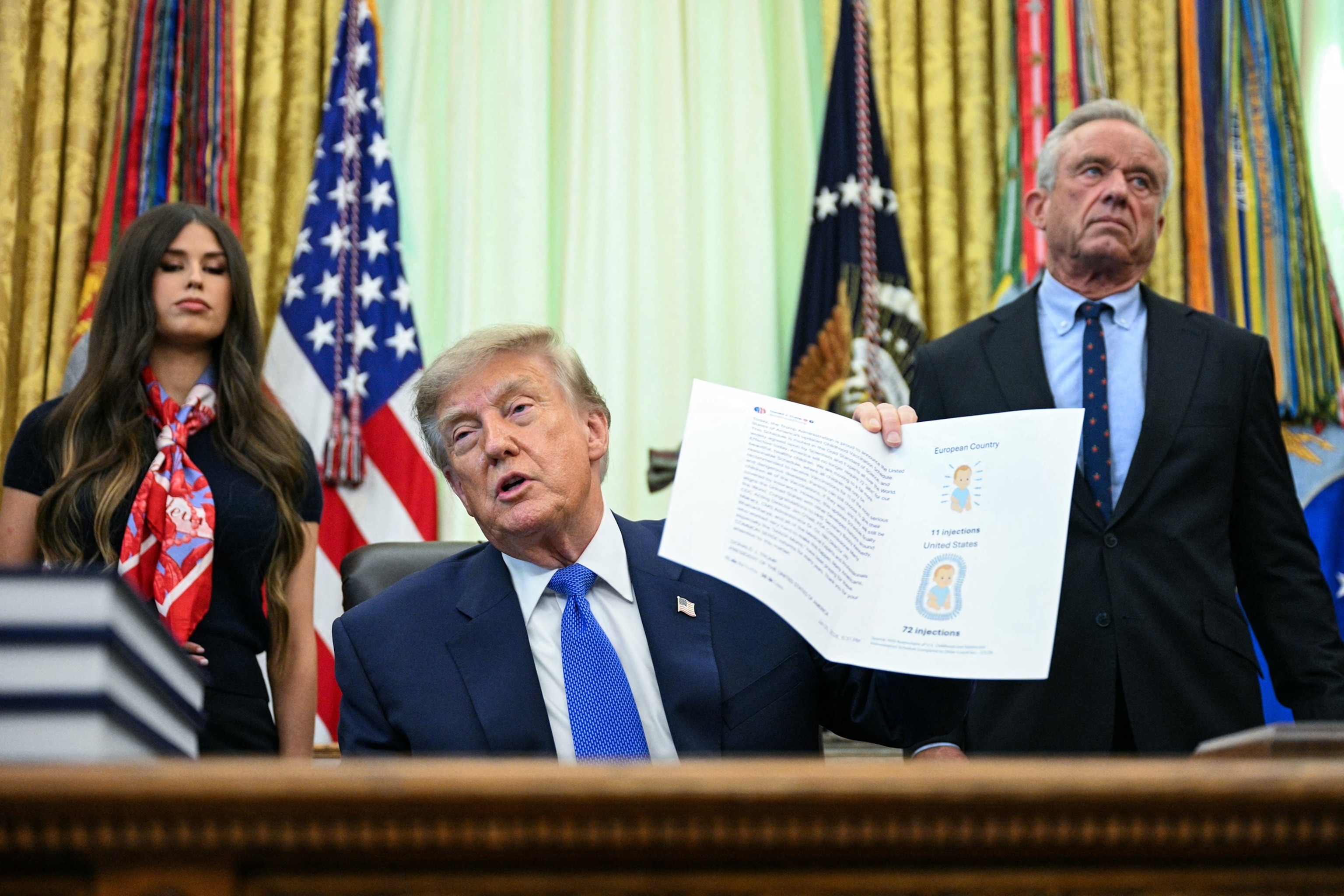
During the signing ceremony in the Oval Office alongside Health and Human Services Secretary Robert F. Kennedy Jr., Trump declared that his administration is “recognizing gold standard childhood vaccine recommendations for only 11 core vaccinations against the most serious and dangerous diseases, along with the MMR, which hopefully will be split up.” The order represents a significant escalation of the administration’s efforts to reshape federal vaccine policy just months before midterm elections.
Trump claimed the combined MMR vaccine could be “quite lethal” when administered all at once, describing it as “the size of a bottle of soda poured into a little child’s body.” He said splitting the vaccines into separate visits spaced over time would be safer, though he later softened his language when pressed by reporters. “Well, let’s say there’s a 5 percent chance of it. Let’s split it up,” he said when asked if he had evidence for his concerns.
The president also recounted his personal approach to vaccinating his own children. “I took my children to five different vaccinations. In other words, I broke it up,” Trump said. “It’s inconvenient. It’s five stops, but it’s something that I think will have a huge impact on autism.”
The executive order reduces the list of diseases for which all children should be vaccinated from 18 to 11. Shots against RSV, hepatitis A and B, rotavirus, meningococcal disease, and influenza would now be recommended only for high-risk children or subject to “shared clinical decision-making” between parents and doctors. All children would continue to be recommended for vaccines protecting against measles, mumps, rubella, polio, whooping cough, tetanus, diphtheria, Haemophilus influenzae type B, pneumococcal disease, HPV, and chickenpox.
The order also directs the Department of Justice to investigate states regarding exemptions for childhood vaccine mandates and calls for improved vaccine safety research, which Trump emphasized should address autism concerns.
The administration’s latest action appears designed to circumvent ongoing court challenges. A federal judge blocked a previous attempt by the administration to change the vaccine schedule in March after the CDC recommended the cuts in January. The new executive order attempts to accomplish similar goals through presidential directive rather than through the CDC’s standard advisory process.
However, the order faces significant hurdles. Separate MMR vaccines do not currently exist in the United States, and companies would need to conduct clinical trials to develop and gain FDA approval for individual shots. The American Academy of Pediatrics has stated it would take a decade to create separate vaccines for each component of MMR. Additionally, legal experts expect the executive order to face court challenges similar to those that blocked the earlier CDC changes.
Kennedy, a longtime vaccine skeptic who has repeatedly questioned vaccine safety, did not directly address the autism question during Monday’s event. Instead, he speculated about environmental causes for rising autism rates. “We’re only noticing it in kids who were born around 1989 or after. The older generations are not seeing those increases. So something happened in the mid ’90s that changed our children, and it has to be an environmental exposure,” Kennedy said. “You need an environmental toxin.”
Not all Republicans embraced the order. Senator Bill Cassidy of Louisiana, a physician who chairs the Senate Health, Education, Labor and Pensions Committee, sharply criticized the executive order on social media. “I’m a doctor. This executive order is wrong,” Cassidy wrote on X. “The President does not have the expertise to make these changes. Vaccines are overwhelmingly safe. Vaccines are effective. Vaccines DO NOT cause autism. Breaking up vaccines will mean children have to get more shots to get the same protection, not fewer shots. It will increase hesitancy and make children less safe.”
Medical organizations have united against the changes. The American College of Physicians called the order “part of a troubling pattern by the administration to attempt to unilaterally change vaccine guidance, particularly for children, rather than relying on the transparent, scientific review that has guided the U.S. Childhood vaccine schedule for decades.”
Public health experts warn that splitting vaccines would require more doctor visits, increasing the likelihood that parents skip appointments and children miss vaccinations altogether. This concern comes as measles cases for 2026 have already surpassed last year’s total, and medical professionals have attributed the rise to declining vaccination rates.
The scientific evidence overwhelmingly contradicts Trump’s claims. Extensive research involving millions of children has found no link between the MMR vaccine and autism. The CDC states there is “no published scientific evidence” showing any benefit in separating the combination MMR vaccine into three shots. A recent large-scale study of more than 2.5 million children published in July 2026 reaffirmed the absence of any connection between MMR vaccination and autism.
Trump’s claims echo discredited theories from Andrew Wakefield, a British doctor whose 1998 study falsely linking MMR to autism was retracted due to serious scientific misconduct and undisclosed financial interests. Wakefield’s license to practice medicine was revoked. In a social media post following Trump’s announcement, Wakefield stated the president was “adopting the very recommendation that I made back in 1998.”
The order comes as the Trump administration appears to be prioritizing vaccine policy ahead of the midterm elections, reversing its earlier decision to downplay the issue. Earlier this year, the White House had urged Kennedy to avoid contentious vaccine discussions, but Trump has reportedly questioned Kennedy about the lack of momentum on vaccine policy changes, signaling his continued personal interest in the topic.
Parents will still be permitted to choose full vaccination schedules if they wish, and the order maintains that insurance coverage should remain available for all vaccines. However, it is unclear whether all parents will have equal access to separate MMR shots, given that they do not currently exist in the commercial market, and whether insurance plans will cover the additional doctor visits required by the new approach.