

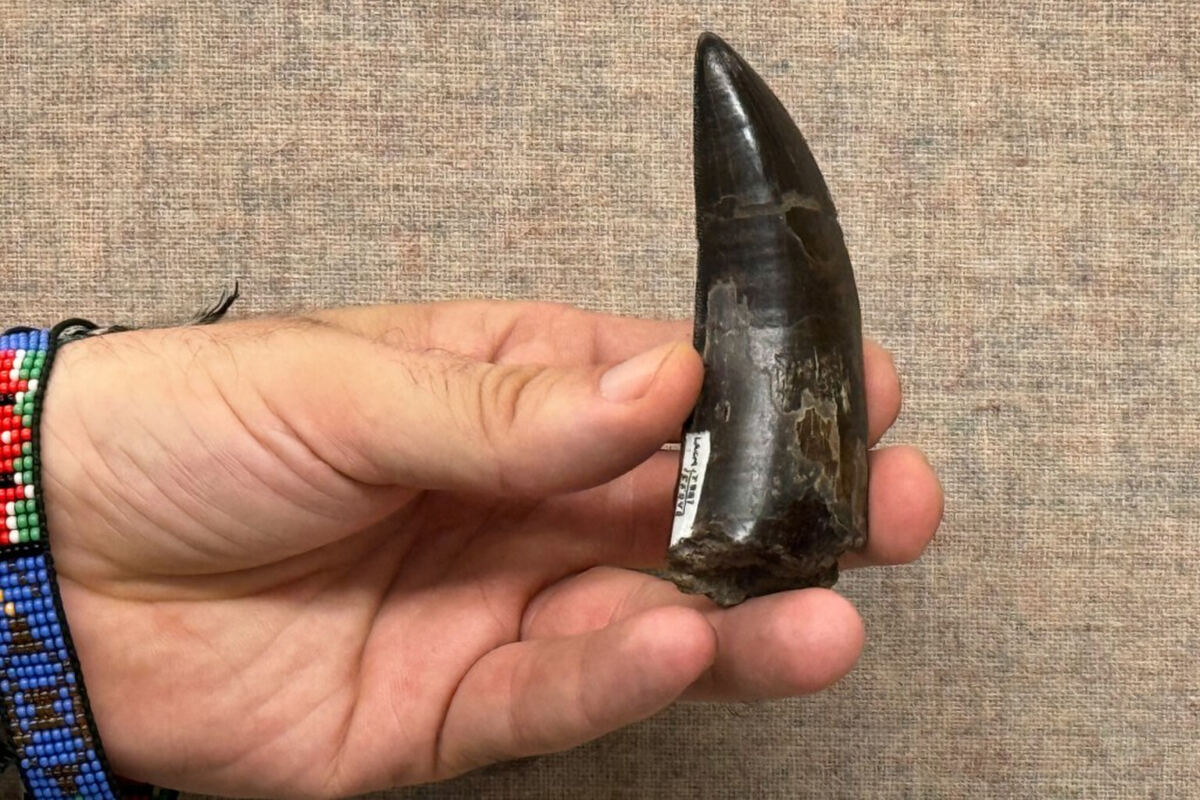
Scientists have extracted a precise body temperature from Tyrannosaurus rex fossils for the first time, and the predator ran almost as warm as a human.
The reading comes from a new study led by geochemists at the University of California, Los Angeles, who analyzed chemical signatures locked inside fossilized tooth enamel. Their findings were published Wednesday in the journal Science Advances.
Three T. Rex teeth yielded an average body temperature of about 97 degrees Fahrenheit, or 36 degrees Celsius. That places the iconic carnivore in the same thermal range as modern elephants and just below the typical human span of 97 to 99 degrees Fahrenheit.
“We figured out how warm the most famous animal of all, a T. Rex, was,” said co-author Aradhna Tripati, a geochemist at UCLA.
The breakthrough hinges on a newly applied technique. Atoms within tooth enamel cluster in distinct patterns that correspond to an animal’s core body temperature, allowing researchers to read ancient thermometers that have been buried for tens of millions of years.
For decades, scientists have debated where dinosaurs fell on the metabolic spectrum. Early assumptions painted them as sluggish, cold-blooded reptiles. Subsequent research pushed toward warm-bloodedness and active thermoregulation, at least among mature individuals.
Most researchers already accepted that T. Rex generated its own body heat. But nailing down an exact figure proved elusive. Growth studies and bone analyses offered hints, yet no firm number emerged.
“We can’t just use a thermometer to do that,” said Jasmina Wiemann, a paleobiologist at Johns Hopkins University who was not involved in the study.
Wiemann found the result somewhat surprising. “I almost would have expected a higher body temperature,” she said. Her own prior work had suggested the predator might have run several degrees hotter, closer to modern birds — the living descendants of dinosaurs.
At 97 degrees, T. Rex could have roamed widely across prehistoric North America without overheating or shutting down in cooler zones, Tripati noted. The stable internal climate would have supported sustained hunting across varied landscapes.
The energy demands of that temperature also offer clues about how much prey the massive carnivore needed to chase down and consume to keep its metabolism fueled.
Study co-author Robert Eagle, a geobiologist at UCLA, sees broader applications ahead. “There’s lots of interesting, charismatic species that could be explored using this,” he said.
The research team now hopes other scientists will deploy the enamel method across the dinosaur family tree. Comparative temperature data could reveal whether T. Rex’s particular thermal profile was unusual or typical among its contemporaries — and whether that warmth helped propel it to apex predator status during the dinosaur age.