

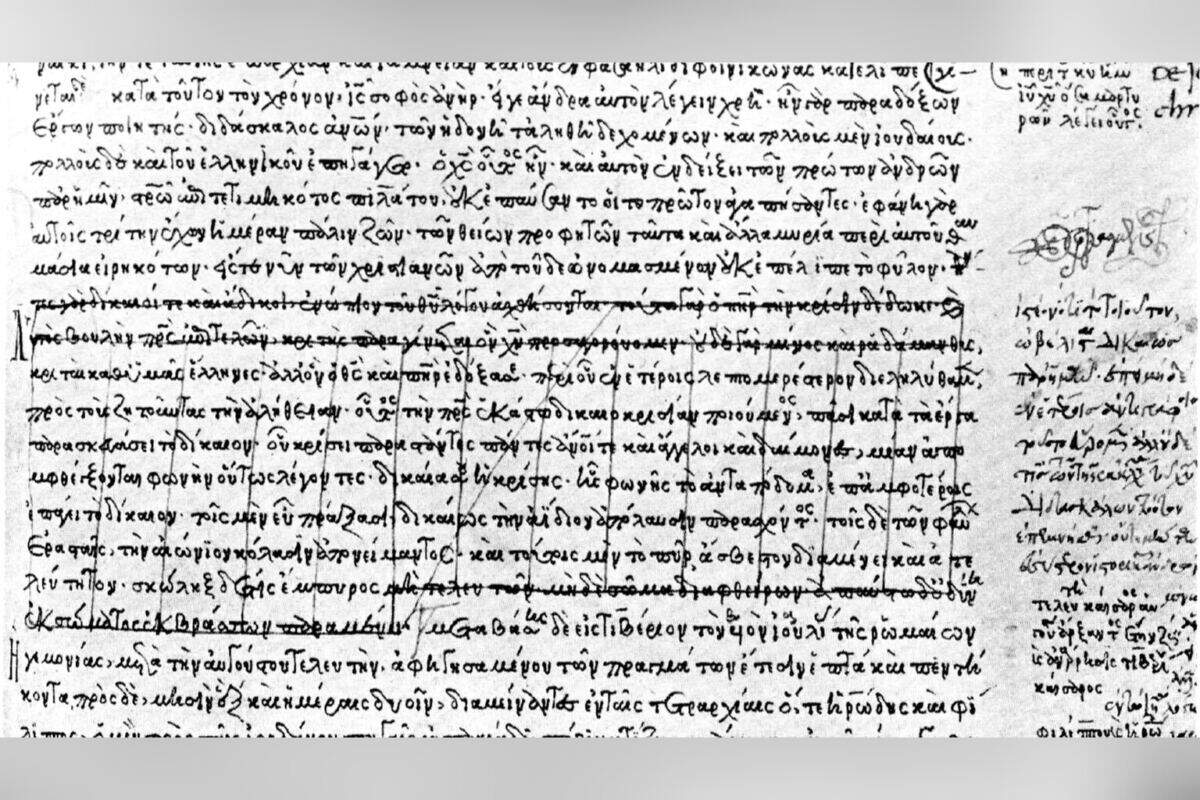
Grok, the AI chatbot developed by Elon Musk’s X platform, has generated a fresh translation of a disputed first-century passage that describes Jesus rising from the dead.
The passage, known as the Testimonium Flavianum, is attributed to Flavius Josephus, a Jewish historian who documented Jewish history under Roman rule. Written around 93-94 AD in his work Antiquities of the Jews, the text references Jesus, his teachings, and his execution by Pontius Pilate. Grok’s translation has drawn new attention to a section describing events three days after the crucifixion.
In its rendering, the AI bot wrote: “About this time lived Jesus, a wise man, if one ought to call him a man. He did surprising deeds, taught those accepting truth gladly, and won many Jews and Greeks. He was the Christ. Pilate crucified him on charges from our leaders; his first lovers did not stop.”
The translation continued: “He appeared to them alive on the third day, as divine prophets foretold these and myriad wonders about him. The Christian tribe named from him has not vanished to this day.”

Historians have debated the passage for centuries, with particular scrutiny falling on phrases that seem to endorse Christian beliefs. The declaration that Jesus “was the Christ” and the explicit description of resurrection have fueled skepticism, given that Josephus was Jewish and not a follower of Jesus. Some scholars argue that Christian scribes altered the original text as it was copied over generations, while others maintain Josephus wrote a core account that was later embellished. The theory that Josephus originally mentioned Jesus with subsequent Christian interpolation remains a significant position in scholarly discussion.
Grok’s involvement marks a novel chapter in this longstanding academic dispute, though the translation does not resolve the fundamental questions about the passage’s authenticity. The AI tool’s rendering adds to a body of translations and interpretations that have circulated for decades, not centuries.

The Testimonium Flavianum appears in Book 18 of Antiquities of the Jews, which covers the period from the death of Herod the Great to the outbreak of the First Jewish-Roman War. Josephus, born in Jerusalem around 37 AD, wrote the work in Rome under imperial patronage. The passage represents one of only two references to Jesus in his extensive historical writings, making it a focal point for researchers examining non-Christian sources about early Christianity.
The broader context involves ongoing efforts to apply artificial intelligence to ancient texts, with varying degrees of scholarly engagement. Grok’s translation joins a growing list of AI-assisted projects targeting historical and religious documents, though experts typically emphasize that such tools cannot substitute for specialized philological and historical analysis.
The passage has survived in Greek manuscripts and translations into other ancient languages, with no original autograph known to exist. The textual tradition thus depends on copies separated from the proposed date of composition by several centuries, leaving ample room for the kind of interpolations that scholars have hypothesized.
Grok’s translation has circulated on X, where the chatbot is integrated into the platform’s features for premium users.